

Tools and gear · Chapter 2
AI for PreSales (Prompting)
How to prompt AI tools for presales work: the basics, good practice, 41 techniques with reusable templates, and the tools worth trying first.
What is prompting?
Prompting means giving general AI tools structured instructions so they do useful PreSales work. It uses what you already do well in discovery, demo design, and RFP (opens in a new tab) work: clear goals, rich context, and careful follow-up. With the right inputs, AI stops sounding generic. It starts behaving like a junior consultant who knows your buyer, your product, and your KPIs (opens in a new tab).
Why prompting matters for PreSales
Weak inputs lead to generic or incorrect answers, which is risky in regulated contexts. PreSales must communicate in a role-aware and KPI aware way across multiple stakeholders. Prompts encode role, context, format, tone, and checks, which turn AI into repeatable workflows you can trust.
- Speed with accuracy: go from blank page to usable draft in minutes for discovery guides, demo flows, and RFP sections. Built-in checks keep you credible in regulated environments.
- Persona fit: speak differently to CFO, COO, CIO, Compliance, and Procurement without rewriting from scratch.
- KPI focus: anchor every output to metrics that matter in supply chain and trade. Those are cost to serve, landed cost, duty savings, OTIF, lead time variance, demurrage, and emissions.
- Repeatability: shared prompts turn best practice into a house style your whole team can use.
A simple mental model
A good prompt follows the same steps as a structured client conversation.
Discovery: state the business outcome, audience, and constraints.
Demo narrative: ask for a clear structure such as Pain, Dream, Fix with one proof metric.
Verification: request assumptions, checks, and a revised final.
Packaging: specify the artefact such as email, storyboard, matrix, or executive brief.
Anatomy of a high quality prompt
- Role: who the AI is acting as.
- Audience: who will consume the output and why they care.
- Objective: the outcome and the decision it supports.
- Inputs: short facts that ground the work such as industry, systems, volumes, constraints.
- Format: table, bullets, email, storyboard, one pager.
- Tone and length: friendly and direct, British English, 120 to 150 words if an email, short sections if a post.
- KPI: the one number to emphasise for this persona.
- Constraints: what to include or avoid such as no jargon, avoid internal codes, do not invent facts.
- Checks: ask for assumptions, confidence, and items needing validation.
- Next step: request two actions with owner and date so the draft moves the deal.
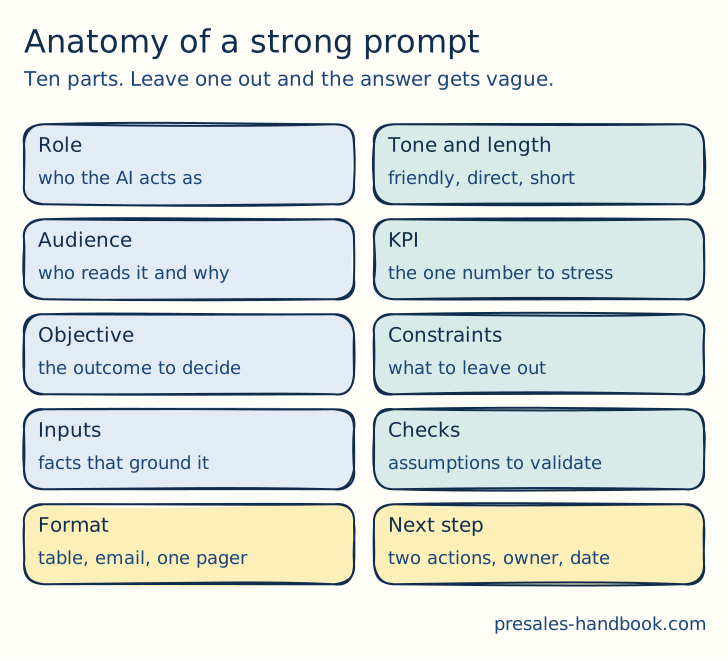
Ten parts of a strong prompt. Leave one out and the answer gets vague.
Before and after example
Input context
- Industry: global apparel importer
- Challenge: demurrage and detention rising 18 percent year on year
- Systems: SAP ERP, CargoWise, Okta SSO
- Stakeholders: CFO and Logistics Director
- KPI to emphasise: demurrage reduction within 90 days
Weak prompt "Write an email about our platform for this client."
Result Generic claims, no numbers, wrong tone for CFO.
Strong prompt
Act as a PreSales consultant (opens in a new tab). Audience: CFO at a global apparel importer and the Logistics Director. Objective: secure a 30 minute working session to agree a 90 day demurrage reduction plan. Context: SAP ERP, CargoWise, Okta SSO. Demurrage and detention up 18 percent YoY. Ports: Felixstowe, Rotterdam. KPI: reduce demurrage within 90 days. Format: 130 word email with subject line and a 3 bullet value summary. British English, plain language. Constraints: avoid jargon, no product features list, tie each point to CFO value. Checks: list 3 assumptions and 2 validation items separately; do not invent figures.
What improves Persona fit, KPI focus, credible ask, clear next step, visible assumptions.
Common pitfalls and fast fixes
Generic outputs: add industry, volumes, systems, constraints, and a gold standard example to mimic.
Hallucinations or out of date facts: ground answers in approved text, allow insufficient data, and add a verification pass.
Persona mismatch: request three variants in one go such as CFO risk and ROI (opens in a new tab), CIO integration and security, COO throughput and adoption.
Opaque ROI math: ask for steps or simple code, include units and time frames, add a 3 bullet executive interpretation.
Over or under specification: set role, audience, format, tone, and length, then ask for 3 to 5 options to explore.
Inconsistent team quality: file prompts and examples in a central library with owners and versions.
Writing strong prompts
Start with the why Connect pains to executive goals. Ask the model to tie each recommendation to a KPI such as on time in full or duty savings.
Use real scenarios Describe workflows, volumes, and systems so benefits are tangible. Ask for a Pain, Dream, Fix frame with one metric of proof.
Quantify the impact Request the steps, simple code, or a calculation outline so the math is auditable, followed by a 3 bullet executive interpretation.
Bring outside proof when allowed Where permitted, include customer quotes and case stats. If sources are required, ask the model to say insufficient data when facts are missing.
Ensure clarity Pick a channel: email, slide, table, one pager. Specify style, tone, and length. Make it accessible to technical and executive readers alike.
Best practices for prompting
Start with the 4Cs: Context, Customer role, Constraints, Custody of output format and tone.
Target the persona and a KPI: for example, CFO plus working capital, Compliance plus penalties avoided.
Request a brief outline first, then expand it after alignment.
Provide a gold standard example to mimic for tone and structure.
Request 3 to 5 options, each tied to a different executive benefit such as cost, risk, speed, sustainability.
Make the math auditable by asking for steps or simple code plus a 3 bullet executive interpretation.
Add a quick verification pass: draft, three checks, revised final with assumptions listed.
Chain the workflow: discovery to demo story to ROI to executive brief.
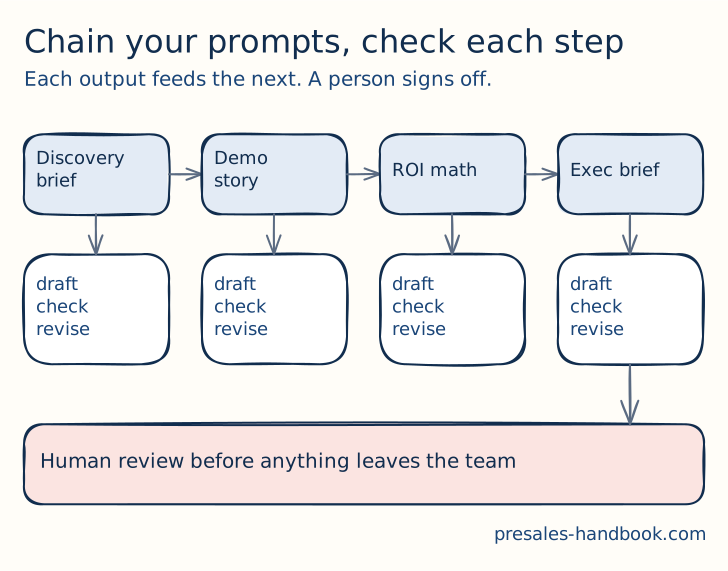
Chain the prompts, check each output, and let a person sign off before it goes out.
Keep a human in the loop for anything regulatory, security, or financial.
Tools to use
Use a research mode when you need current facts with sources, and a chat assistant for drafting and dialogue. The AI toolkit (opens in a new tab) covers the current tools, connectors and models.
ChatGPT Prompt Master
What the GPT Can Do for You
1. Improve Any Prompt
Make your AI prompts clearer, more specific, and tailored to your use case (e.g., discovery, demos, objection handling (opens in a new tab), ROI).
2. Build Reusable Prompt Templates
Help you create and structure prompts that can be reused across your team, with guidance on audience, tone, format, and role alignment.
3. Match the Right Technique to Your Goal
I can apply advanced techniques from your AI Guidebook (e.g., Role Prompting, Framework-Driven, Step-by-Step, Self-Consistency) to ensure higher-quality output.
4. Turn Tasks into Prompts
Give me your task (e.g., "prepare a compliance demo for a logistics manager"), and I'll turn it into a fully optimised prompt with optional variations.
5. Suggest Prompt Frameworks
Recommend the best frameworks (such as SPICED, MEDDICC, or RISEN) to structure your questions, messaging, or analysis.
6. Review and Refine Existing Prompts
I can critique a prompt you already have and provide a better version, including reasoning and improvement steps.
Prompt Master (opens in a new tab)
ChatGPT PreSales Handbook
The GPT provides end-to-end support across the PreSales lifecycle, including:
- Discovery: Sales, Functional & Technical, and Services Discovery using structured templates like the FTD (opens in a new tab) and OSD (opens in a new tab).
- Qualification: Using BANT (opens in a new tab), CHAMP, and MEDDIC frameworks.
- Demo Excellence: Help you prepare, execute, and follow up using the Master Demo Deck and Cheat Sheet Demo.
- ROI & POC (opens in a new tab): Guide you through ROI calculation, value selling, and Proof of Concept planning and execution.
- RFX Strategy: Support with RFP/RFI responses and qualification to decide when to pursue or walk away.
- Competitive Positioning: Help you stand out with storytelling, objection handling, and buyer journey engagement.
PreSales GPT (opens in a new tab)
AI Guidebook for PreSales
Presales teams in Supply Chain and Global Trade deal with complex operations, strict regulations, and many stakeholders who want different things. You interact with buyers from many roles such as COO, CFO, Head of Logistics, Trade Compliance Officer, IT Security, and Procurement. At the same time, you need to defend your solution design under scrutiny. You also have to show value through measurable metrics. Those metrics are cost to serve, landed cost, duty savings, on-time in-full delivery, lead-time variance, demurrage, and emissions reduction.
Prompting means giving clear and structured instructions to AI tools like ChatGPT. It can dramatically improve the speed, quality, and consistency of your presales work. It helps with sharper discovery questions, stronger demo flows, faster RFP responses, more credible ROI models, and better objection handling.
This guide distills both foundational and advanced prompting techniques into practical templates tailored for Supply Chain and Global Trade. The goal is AI output you can rely on, without generic answers.
You'll find:
- An overview of the tools available and what they are best suited for
- How to use AI tools effectively in presales
- A short primer on why prompting matters in presales
- 41 techniques, grouped into Foundational, Reasoning and Exploration, Verification and Safety, Workflow and Automation, and Multi-Perspective and Creativity
- For each technique: what it is, why it helps, when to use it, common pitfalls, a reusable template, and domain-specific examples
- End-to-end playbooks for discovery, demo design, ROI analysis, architecture and security reviews, RFP strategy, and objection handling
If you're looking for a quick option and prefer not to read this lengthy document, use the ready-made Prompt Master. It contains all the best prompting techniques.
ChatGPT Prompt Master (https://chatgpt.com/g/g-67c4a0acccb48191adbba664a1b24c8a-prompt-master (opens in a new tab))
AI Guidebook for PreSales (opens in a new tab)
Prompting techniques library (opens in a new tab)
PreSales perspective
Treat structured prompting as a standard part of discovery, demos, ROI work, and RFPs. Start early, qualify hard, and encode role, context, KPI, constraints, and output format in every brief. Use AI for speed where it helps most such as drafting, synthesis, and exploring options. Keep a human in the loop for judgement calls, compliance, pricing, and final sign off. Treat verification and versioning as standard practice so you gain speed without trading away accuracy or trust.
So what for PreSales perspective
- Win time where it matters Move from blank page to usable drafts for discovery guides, demo storyboards, and RFP sections in minutes, then spend saved time on client conversations.
- Raise executive credibility Produce persona specific, KPI anchored outputs that you can defend in front of CFO, COO, CIO, Compliance, and Procurement.
- Tell clearer stories Turn pains into Proof plus Next step with one metric that carries from discovery to demo to decision.
- Make the maths auditable Request steps or simple code and add a three bullet executive interpretation so ROI stands up under scrutiny.
- Reduce compliance risk Ground claims in approved sources, require assumptions and confidence, and allow insufficient data when facts are missing.
- Scale consistency across the team Reuse shared prompt patterns and templates so every asset reflects a repeatable house style.
- Improve qualification and focus Use assumptions first and trade off prompts to decide where to invest effort, and where to politely no bid.
- Link work to hard KPIs Tie outputs to cost to serve, landed cost, duty savings, on time in full, lead time variance, demurrage, and emissions so progress is measurable.
Templates for this chapter
 Included with the courseDOCX · 2.4 MB
AI guidebook for presales
How to use AI tools in discovery, demo prep, RFPs and follow-ups, with example prompts.
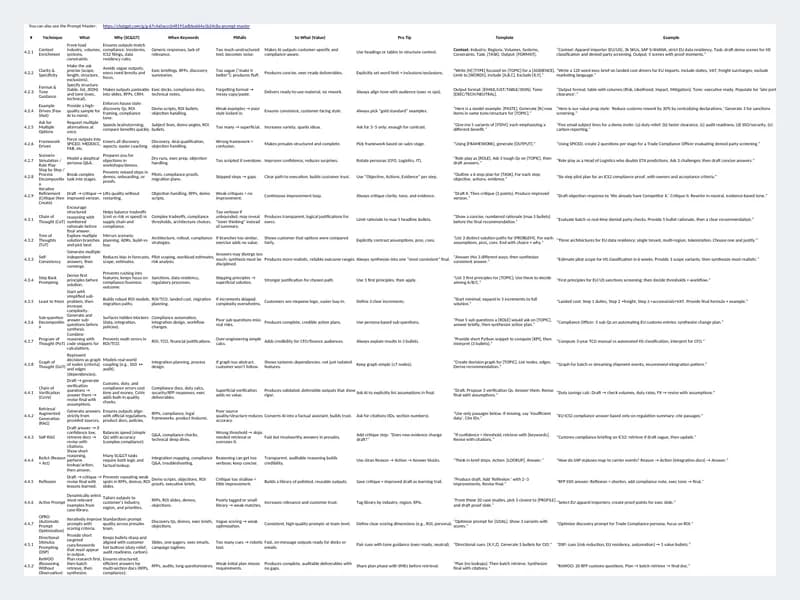 Included with the courseXLSX · 29 KB
Prompting techniques library
A sortable list of prompting techniques with when to use each one.
From the blog
- 5 min read
Automation Isn’t Replacing PreSales! It’s Elevating It!
Automation takes repetitive work off presales teams so they can spend more time on discovery, strategy and real customer conversations.
Read more - 6 min read
AI Won’t Replace PreSales Teams, But PreSales Professionals Who Use AI Will Replace Those Who Don’t
AI will not replace presales teams. People who use it well will outpace those who don't. Where AI helps today and how to start.
Read more - 8 min read
Top 19 Focus Areas for Presales Professionals in 2025
Nineteen areas for presales to focus on in 2025, from storytelling and personalised demos to AI, buyer enablement and ethics.
Read more