
Playbook · Chapter 3
Functional & Technical Discovery
How to run functional and technical discovery: what to ask, how to structure it, and how the answers shape a demo that fits.
Key takeaways
- Functional and technical discovery (FTD) is where you win the edge. You learn the customer's processes, systems and gaps before you propose anything.
- Work through the steps in order: prepare, gather information, assess the technology, interview stakeholders, find the gaps, validate and document.
- Turn every finding into value. Match your solution to the pains you uncovered and write it down in the OSD.
Video: Functional & Technical Discovery (FTD)
Functional / Technical Discovery (FTD)
In a fast sales environment, you need to understand the prospect's requirements and technical details. The first sales discovery (opens in a new tab) meetings often focus on broad goals and ambitions. The detailed functional and technical discovery that follows often decides whether a sale succeeds or fails. This chapter covers the Functional/Technical Discovery phase. It draws on earlier insights and methods to build a full approach to this key point in the sales cycle. (Cohan 2022) (opens in a new tab)
Peter Cohan writes in his book that discovery is the stage of the process that gives you a competitive advantage (Cohan 2022) (opens in a new tab):
The client's trust grows as you learn about and explore their wishes and goals.
The demo becomes more personal, more focused on results and more valuable.
After this book, I recommend you read Doing Discovery by Peter Cohan. He goes into much more depth on how to run a proper discovery and win the client over. Taking one of his courses also gives you a personal competitive advantage. It has helped me a lot in my own sales cycles.
Why is it important?
For Vendors: Discovery lets vendors fully understand a prospect's needs. With that understanding they can propose an exact answer, which makes a sale more likely. (Cohan 2022) (opens in a new tab)
For Prospect: Through discovery, prospects can tell which vendors really understand their requirements. A vendor who invests time in a thorough discovery often stands out, because it can describe the prospect's environment, culture and challenges accurately. (Cohan 2022) (opens in a new tab)
At its most basic, discovery means collecting knowledge. When you understand the prospect's problem thoroughly, your proposed solution fits it exactly. In its simplest form, discovery is defined as "the process of gathering knowledge to enable a detailed suggestion of a solution to a prospect problem".
Skipping discovery and jumping straight into a product demo is like a doctor handing out medicine without first checking what is wrong with the patient. It comes too early and can even do harm.
In presales, discovery connects understanding with solutions. It is how you build relationships and make sure your solution fits each prospect's specific challenges and plans.
The Dual Benefits of Discovery
Discovery matters in presales for vendors and prospects alike. Vendors learn the prospect's needs in depth, so they can propose precise solutions and raise their chances of a sale a lot. Prospects use discovery to find out which vendors really understand their requirements. A vendor who takes the time to understand a prospect's environment, culture and challenges stands out, because it reflects the prospect's needs accurately.
Discovery is about gathering knowledge. That knowledge lets you tailor a solution that fits the prospect's problem exactly. Skipping this step is risky. In presales, discovery connects the prospect's specific situation with solutions that really solve their challenges and serve their goals.
Good discovery needs two things at once. You gather enough insight into the prospect's problems, and you build a strong relationship with them. The goal is to collect all the information you need to recommend the right solution with confidence. This helps vendors position their solution better. It also makes sure the solution fits each prospect's specific needs and plans.
The Process of Doing Discovery
The presales discovery process is a systematic way to understand potential clients and tailor solutions to their specific needs. Here are the steps:
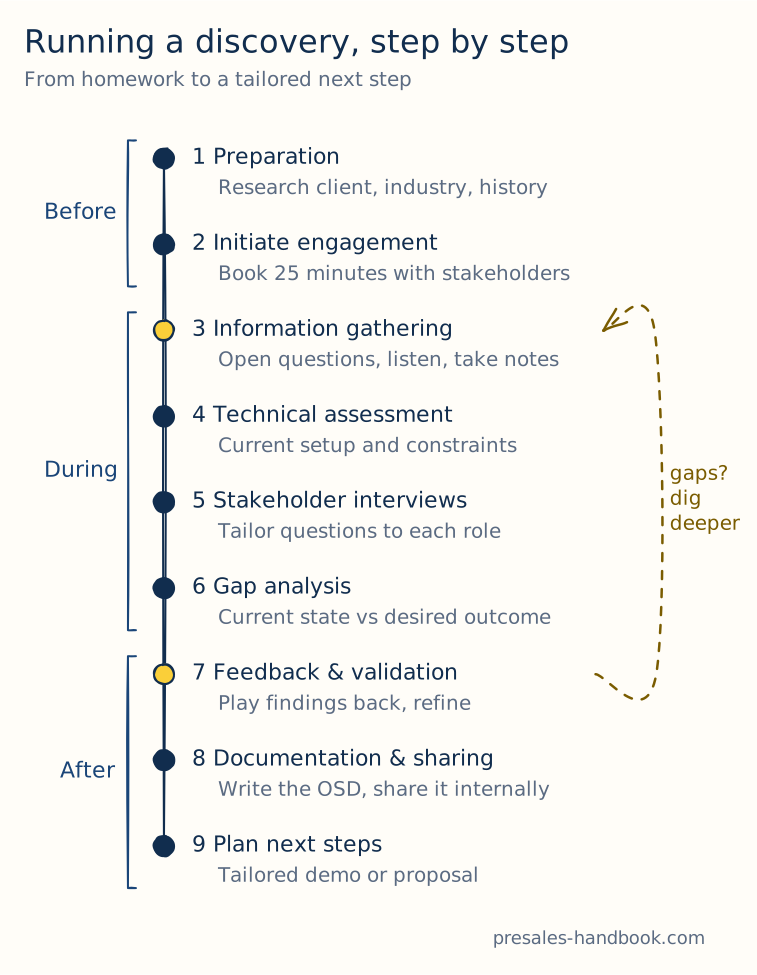
The nine discovery steps. If validation shows gaps, go back and dig deeper.
Preparation: Learn the background of the client and their industry. Do some research up front, review past interactions and prepare open questions to get the discussion going.
Initiate Engagement: Prepare the ground for a constructive dialogue. Schedule a discovery session with the key stakeholders. We recommend 25 minutes for the first one. This shows commitment and that you want to understand their needs and challenges better.
Information Gathering: Use open questions and active listening to find out the client's wants, needs and pain points. Write down all answers for later reference. AI tools that summarize conversations can help here.
Technical Assessment (if applicable): Assess the client's current technical setup and any constraints that could affect integration with new systems. Note the challenges you see.
Stakeholder Interviews: Talk with stakeholders across the client's organization to get a wide range of views. Adapt your questions to each person's role and make sure the setting is comfortable enough for an open conversation.
Gap Analysis: Use the information you collected to find the gaps between the client's current state and the outcomes they want. Rank these gaps by impact and urgency.
Feedback and Validation: Share a summary of your findings with the client. This confirms your understanding and checks it against their expectations. Refine your findings based on their feedback.
Documentation and Sharing: Document all findings, insights and feedback systematically. Share the documentation with the sales, technical and product teams so everyone has the same picture. Tools like the Opportunity Scoping Document (OSD) help here.
Plan Next Steps: Use what you learned in discovery to tailor your solution or proposal to the client's specific needs. Then schedule follow-up sessions or demos that show how your solution solves their challenges.
Interested in the Discovery Framework
The functional and technical discovery template is a free download.
Templates and downloads (opens in a new tab)
Structured Approach to Discovery
One discovery session has a shape. You open warm, dig through the business layer by layer, and close with where the customer wants to go. The diagram shows the eight phases and what you write down in each.
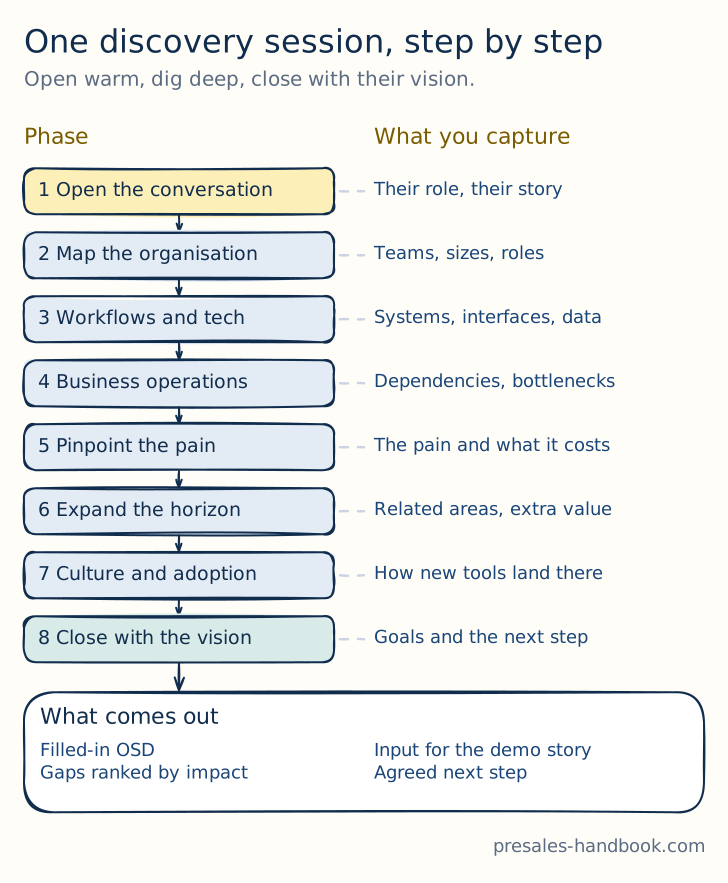
Eight phases, one page of notes per phase. The session ends with an agreed next step.
Opening the Conversation: Start with questions that build rapport and set a warm, friendly tone. This builds a connection and makes the prospect more open. A question that shows real interest in their career path is a good start. (Rackham 1995; Greene 2018)
Deciphering Demographics: Map the organizational structure: team sizes, roles and workflows. Your solution builds on this picture of the structure.
Understanding Workflows and Tech Infrastructure: Collect information about the systems already in place, so your solution integrates with them.
Understanding the Supply Chain & Business Operations: Find the dependencies, bottlenecks and weak points in the supply chain.
Pinpointing Pain Points: Identify the core challenges. Find out where the problem hurts most, so you can offer relief exactly there.
Expanding the Horizons: Beyond the immediate challenges, related areas may be affected. Looking at them can show further value your product could bring.
Culture & Integration: Understand the company's values and how it adopts new solutions. Then your offer fits the way the company works.
Concluding with Vision: Close the session with the prospect's view of the future. This confirms you agree and sets out the plan for the next meetings.
What Comes Out: You leave with four things. A filled-in OSD (opens in a new tab) and a list of gaps ranked by impact. The raw material for your demo story. And a next step the customer agreed to. If you leave without that last one, you had a nice chat. You did not have a discovery.
Techniques for Effective Discovery
Good discovery uncovers a prospect's core issues, needs and goals one layer at a time. Presales professionals use several techniques for this. Each one gives insight into a different part of the prospect's situation.
Open-Ended Questions: These invite the prospect to say more than yes or no and to describe their challenges and needs. They uncover problems and show how serious they are and what they affect.
Active Listening: An engaged way of listening. You understand the words and also the emotions and concerns behind them. When you reflect and summarize what the prospect said, you confirm their concerns and clear up misunderstandings.
Empathy Mapping: A tool that helps you see the situation from the prospect's side and understand how they experience it. It sorts feedback into what the client Says, Feels, Does and Thinks. That gives a rounded view of their challenges.
SWOT Analysis: This tool looks at the prospect's Strengths, Weaknesses, Opportunities and Threats and gives a full picture of their business. It shows where they have an advantage and where the risks are, so your proposed solution is effective and complete.
The 5 Whys: A questioning method that goes one level deeper with each "why" until you reach the root cause. A surface understanding turns into real insight, and you find the underlying issues that need solving.
Common Challenges in Discovery
Discovery helps you understand a potential client's challenges, needs and goals. But several difficulties can get in the way of a solid shared understanding. These are the common ones, and how to deal with them:
Surface-Level Information: Clients often give generic answers in discovery meetings. They describe the broad picture without much depth. That makes it hard for presales teams to see the details of the client's issues and to tailor a solution.
Defensiveness: Some clients come to discovery sessions on guard. They hold back information because they fear a sales pitch. This slows the flow of useful insights, and presales has to work with too little information.
Misalignment: In organizations with many stakeholders, people disagree on what the "primary challenge" is. That makes it hard to identify the core issues and to propose solutions that satisfy everyone.
Time Constraints: Prospects often give discovery sessions only limited time. Then you have to rush the information gathering. You may miss things or understand the client's needs only in part.
Once you know these challenges, you can plan for them. Sharpen your techniques, build real relationships with clients and observe closely. Then these obstacles lead to deeper engagement and better solutions. Handling them well also shows the adaptability and resilience presales work demands.
Overcoming Discovery Challenges
In discovery, you need to overcome these obstacles to build real connections with potential clients. These strategies help:
Building Trust: Take the prospect's hesitation seriously. Build trust by showing real interest in their challenges, and do not focus only on making a sale. Be transparent and listen first. Prospects then open up and are ready for deeper discussions.
Engaging All Stakeholders: B2B decisions often involve several stakeholders, each with their own view and priorities. Involve all relevant people to get a complete picture of the challenges and needs. Then your proposed solution fits the wider goals of the organization.
Adopting a Flexible Approach: Adapt the discovery process to what the prospect is comfortable with and prefers. That can mean shorter sessions, different questioning tactics or patience with their schedule. This keeps discovery a real dialogue.
Using Testimonials: Testimonials and case studies of past successes show the value of a thorough discovery. Real examples give concrete evidence of the benefits. They also build trust because they show what a deep discovery can lead to.
Translating Discovery into Value Propositions
Uncovering the challenges and understanding the operational context is only the start. Presales then has to connect the client's challenges with the specific value your solution brings. You take the insights from discovery and shape them into convincing value propositions.
Align Solutions with Pain Points: Start by matching your solution precisely to the issues the client named. For example, a client may struggle with old software that slows down real-time data analytics. Show how your solution removes the delay and processes the data efficiently. When you make this direct link, the prospect sees a solution built for their situation.
Show ROI: Besides explaining how the solution solves the pain points, show its economic impact. Build a potential Return on Investment (ROI (opens in a new tab)) model. It shows how your solution can improve efficiency, reduce customer churn or increase revenue. Use concrete metrics to back up the value proposition.
Craft Tailored Demos: Use what you learned in discovery to build demos that speak to the prospect's situation. Show the functions that solve their specific challenges, for example by playing through real scenarios from discovery. This shows how relevant your solution is. It also lets the prospect picture a future in which their issues are solved.
Doing a Demo in a Discovery
A basic rule in presales is to never run a demo without discovery first. You need to understand the client's needs before you show solutions. Still, stay flexible, especially when sales partners or clients ask for a demo up front.
This is how you handle such situations:
Use the Initial Interest: Use the prospect's curiosity to give a broad overview of what the solution can do. Keep this first pitch short and focused on the big picture. Leave the detailed functions for later.
Run a "Look & Feel Demo": Give a short preview of the interface and the basic capabilities. The aim is to make the prospect want a more detailed look in a later meeting. Do not get caught up in specifics.
Avoid Going Deep Too Early: Curious prospects may ask detailed questions. Acknowledge these questions and suggest a closer look once a full discovery is done. This keeps the conversation focused and productive.
Integrate Discovery into the Demo: Use the demo to ask probing questions. The demo then becomes an interactive session that also works as discovery. This takes presentation skills plus the ability to draw out the prospect's challenges and needs.
Provide Supplementary Materials: After a short demo, offer further material such as brochures, whitepapers or automated demos. They prepare the ground for a more detailed and targeted demo later.
PreSales Perspective
Functional/Technical Discovery lets you tailor solutions to the prospect's specific needs, challenges and operational context. It goes further than the first sales discovery because it covers technical details and functional requirements in depth. In the end it often decides whether the sale succeeds.
Peter Cohan stresses the competitive advantage that good discovery gives. He notes that it builds client trust, leads to personal demos that show value and makes a sale much more likely. Discovery lets vendors understand prospects fully and propose solutions that meet their needs directly. Prospects, in turn, can see which vendors really understand their requirements. Vendors who invest time in a thorough discovery stand out.
Discovery means collecting useful insights and refining them into convincing value propositions. It starts with matching the solution to the prospect's pain points and stressing the benefits for their specific challenges. It also means showing the solution's concrete impact, especially with ROI metrics, to make the economic benefit clear.
Tailored demos bring these value propositions to life. Base each demo on what you learned in discovery and focus on the functions that meet the prospect's specific needs. Avoid a generic feature tour. This confirms the solution's relevance and gives the prospect a view of a future in which their challenges are solved.
Sometimes a prospect asks for a demo before any discovery. Then you have to balance their interest with your need to understand them first. One strategy is a short overview that uses their initial interest. Another is a "Look & Feel Demo" that gives a first impression of the solution. A third is to work probing questions into the demo itself. This flexible approach gets you the critical insights and keeps the prospect engaged.
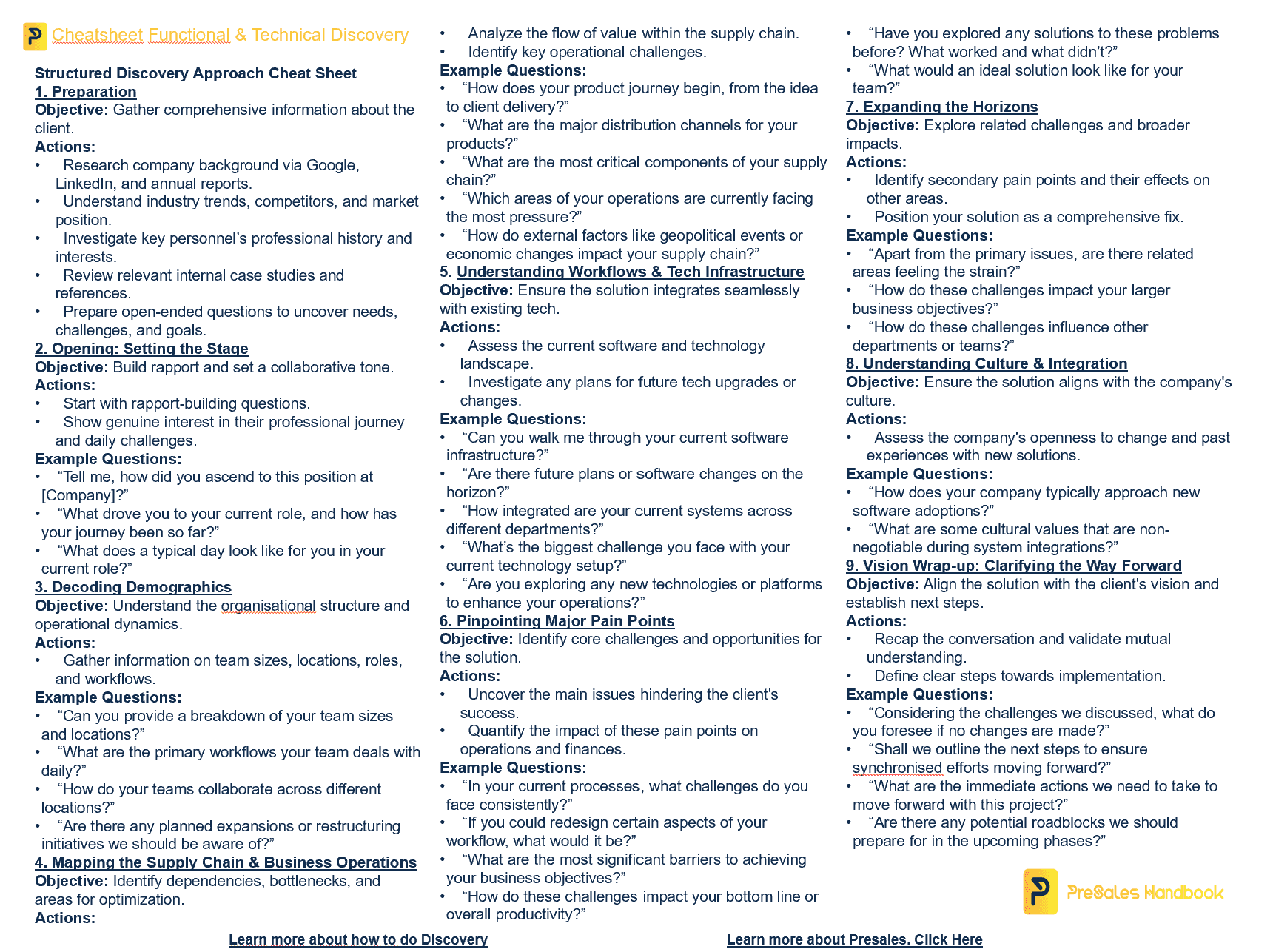
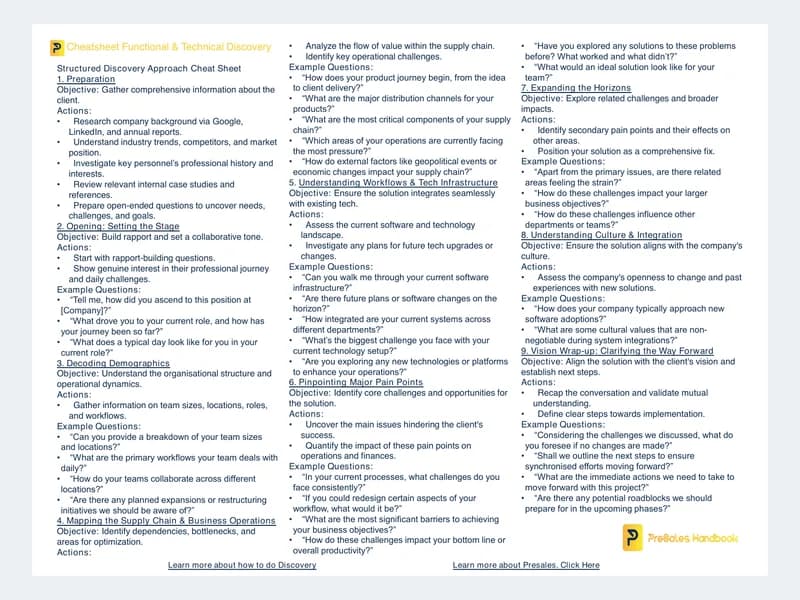
Cheatsheet FTD
Templates for this chapter
 PDF · 111 KB
Functional and technical discovery cheat sheet
The discovery framework on one page, ready to keep next to you in the workshop.
 Included with the coursePPTX · 2.7 MB
Discovery guidebook
A slide template to plan and run a functional and technical discovery workshop.
 Included with the coursePPTX · 2.3 MB
Functional and technical discovery template
Capture critical business issues, problems, capabilities and value in one structured deck.
 Included with the coursePPTX · 2.4 MB
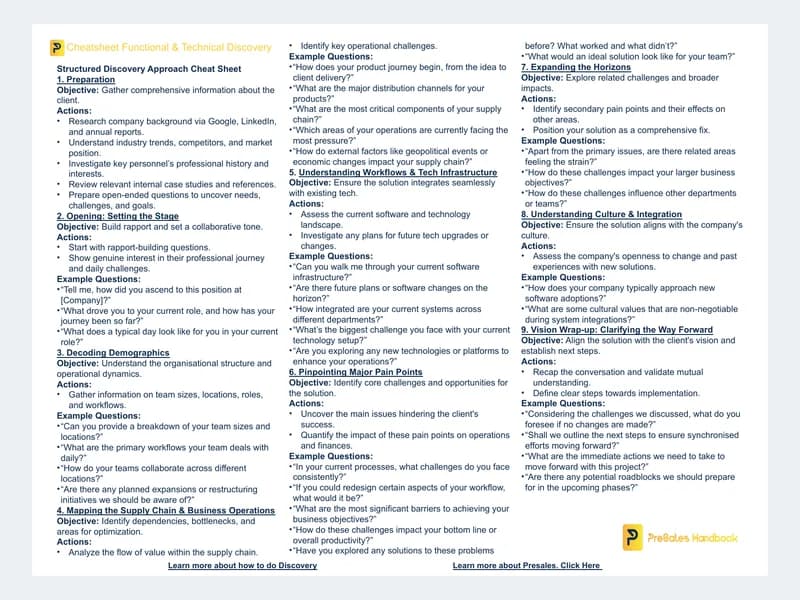
Discovery cheat sheet (editable)
The same cheat sheet as slides, so you can adapt it to your product and team.
From the blog
- 5 min read
The Power of Curiosity in PreSales: Why It’s Your Greatest Asset
Curiosity drives better discovery, stronger relationships, sharper demos and calmer objection handling. Why it is a core presales skill.
Read more - 5 min read
Why Salespeople Need PreSales Skills and How to Acquire Them
Salespeople who learn presales skills win more trust and more deals. Which skills matter most and how to learn them.
Read more - 2 min read
Buyers Don’t Hate Salespeople! They Hate Being Sold To
Buyers want guidance, not pressure. How sales and presales can help buyers decide instead of pushing them toward a signature.
Read more
In the course
- Functional & Technical DiscoveryMembers only
- Functional & Technical Discovery Best PractisesMembers only
- The Discovery Summary / Opportunity Scoping Document (OSD)Members only