
AI
The PreSales Handbook, 2nd Edition, is out today
The 2nd Edition adds AI, 30 chapters, 80 new diagrams and my verdict on every topic. Read what changed and one extract on deal slots.
The 2nd Edition of The PreSales Handbook is out today.
I wrote it because the job changed. In the last twelve months, AI moved from the edge of PreSales into almost every step of a deal. Buyers ask an assistant about you before they ask you. A notetaker joins most calls. A discovery summary or a recap email takes minutes. Demo agents show a product with no solution consultant (opens in a new tab) in the room.
The first edition treated AI as something on the horizon. It is now part of the daily work.
My view, and you may disagree: AI did not make the Solution Consultant (SC) less needed. It changed where the SC earns their place. Drafting got cheap. Judgement, qualification, reading the room and standing behind a promise cost as much as they ever did.
What is new, in a nutshell
More structure, less repetition. The book has 30 chapters in eight parts, up from 24. Each topic is taught once and other chapters point to it. The demo now fills six chapters, from why it persuades to the two days after it, plus demo automation (opens in a new tab) and demo agents.
One new chapter on AI. Chapter 29 covers PreSales in the age of AI in one place. It is the only chapter that names products, because products change faster than books.
An "In 2027" box in every craft chapter. A short box on what AI changed in that specific task.
My take instead of Key Takeaways. Every chapter now ends with my own verdict and a short list of what to do and what not to do.
More than 80 new diagrams. Drawn for this edition. They carry what used to take pages of prose.
New material where the job moved on. MEDDPICC (opens in a new tab) now stands next to BANT. The value case adds payback, total cost of ownership and the cost of inaction. The technical win gets its own section, and so does the hybrid meeting room.
Shaped by 65 experts. I also drew on the interviews for my third book, 1000 Years of PreSales.
The five rules on the cover did not change: Discover, Qualify Hard, Tell the Story, Listen and Stay Honest. AI made each of them harder to fake.
A taste: your year has fewer deal slots than you think
Here is a short extract from chapter 7, Qualify Early, Qualify Hard. I picked it because it is the chapter I wish someone had given me in my first year.
Take a solution consultant with a quota of $1.5 million. They are good. They close about 35 percent of their deals. A typical deal is worth $300,000 and takes 80 to 160 hours.
Put all 1,600 working hours into deals and they could work 10 to 20 opportunities. Now make it realistic. Spend 70 percent of your time on deals and 30 percent on learning, and you have 1,120 hours. That is seven to 14 opportunities.
At a 35 percent close rate, the wins come to $0.74 million to $1.47 million. Even the fast consultant finishes just short of quota.
You have a small, fixed number of deal slots each year. Every slot you give to a deal you should not have taken is gone. At this deal size and close rate, each slot is worth about $105,000 of expected revenue.
That is why "Could we win this?" is the wrong question. Almost any deal could be won by someone. Ask instead: "Is this deal worth the hours, compared with the other deals we could spend them on?"
My take, from the end of the chapter: qualifying hard is the most important discipline in the book. It is also the one I learned last. As a young SC I measured myself by how busy I was. Busyness is not the goal. Most bad deals were visible in the first month. We kept working them because we hoped.
The full chapter goes further. It prices a single eight-month deal at $24,000 of direct time. It maps BANT to MEDDPICC and shows the three letters that cause most late losses. It adds the two gates, commercial and technical. It ends with how to say no in three steps, in a way that brings clients back. The handbook site covers the topic too, in Qualification (opens in a new tab).
Who should read what
New to PreSales? Read Parts I to IV in order. They follow one deal from first call to proof of value (opens in a new tab).
Experienced SC? Use the problem table at the front of the book and jump to your chapter. Then read the "In 2027" boxes and chapter 29.
Leading a team? Start with Part VII, then chapters 7 and 10. Qualification is where your team's hours are won or lost.
Get the 2nd Edition
The 2nd Edition is available now as paperback, hardcover and Kindle. It is new in German and English.
- Amazon Germany (opens in a new tab)
- Amazon US and other countries: see the book page (opens in a new tab).
If you read the first edition, thank you. Your feedback shaped this one. Tell me which chapter you want to see in the next newsletter.
Topics covered in the book
- Defining PreSales and its importance in the SaaS business model
- The role of a PreSales professional
- The buying and selling journey (opens in a new tab)
- Building a champion
- Sales discovery
- Qualify early, qualify hard
- Functional and technical discovery (opens in a new tab)
- Discovery summary and Opportunity Scoping Document (opens in a new tab) (OSD)
- Technical and functional qualification (opens in a new tab) (TFQ)
- Return on investment (opens in a new tab) (ROI) and value calculation
- The demo (Tell the Story)
- Demo automation
- Proof of Concept (PoC)
- The RFX (opens in a new tab) process (RFI, RFP, RFQ)
- Objection handling
- Closing
- Close won and close lost: lessons learned
- Staying up to date
- Documentation and knowledge sharing
- Competition
- Personal branding for PreSales professionals
- PreSales leadership
- Metrics and KPIs for PreSales
About the author
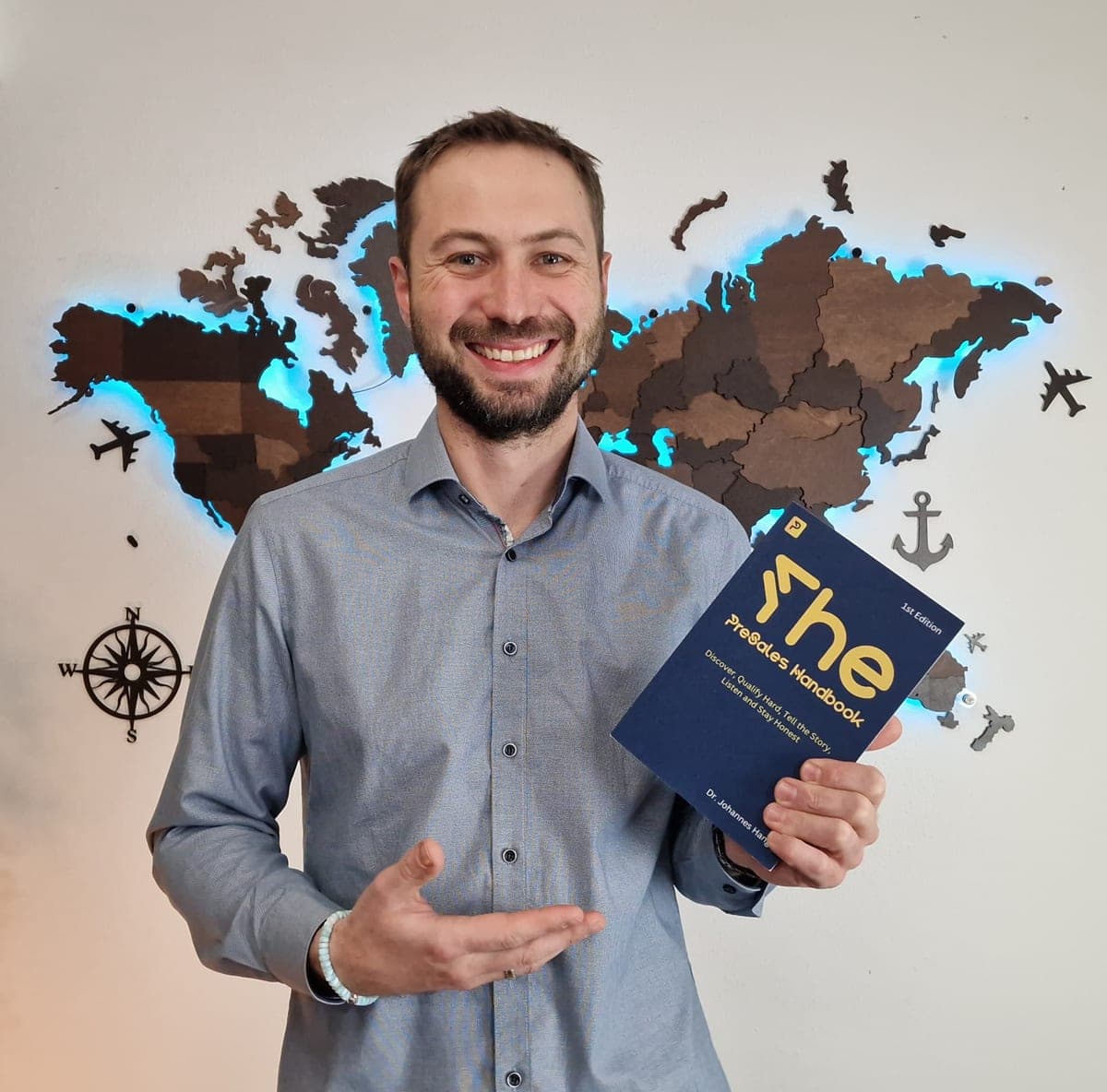
Dr. Johannes Hangl
Presales leader with more than a decade in B2B software. I write about what works in real deals: discovery, demos and the people side of selling.
Related handbook chapters
- The PreSales Consultant: Role, Skills and ResponsibilitiesSelling journey
- Selling JourneySelling journey
- QualificationPlaybook