

Playbook · Chapter 2
Qualification
Qualify early, qualify hard. How to use the OSD and an opportunity review call to decide which deals deserve your team's time.
Qualify Early, Qualify Hard
Qualifying hard in presales means making sure the deal can succeed for both sides, the selling organization and the potential client. The aim is a win-win situation and a lasting partnership. You do not meet prospects with doubt or suspicion. These are the key parts and benefits of qualifying hard:
Strategy Over Skepticism: Qualifying hard checks that both sides are set up to succeed. You take the client's intent and credibility at face value. You assess whether the client is ready for the product or solution, and whether the vendor can meet their expectations.
Assessing Fit: Not every product or solution fits every potential client. Check early whether your offer solves the client's specific challenges. This saves time and resources, because you focus your effort where success is most likely.
Engaging with Decision Makers: Identify the key decision-makers in the client's organization early and talk to them. This makes the decision process clear. It also helps you aim the sales strategy at the people who have the final say.
Setting Clear Expectations: Agree clear expectations from the start on timelines, deliverables, costs and support. Then both sides share the same understanding. This reduces the risk of surprises and misunderstandings.
Understanding Client Readiness: Tools like the BANT framework (opens in a new tab) help you judge how ready a prospect is. Then you put your effort where there is real interest and the capacity to buy.
Using the OSD to Qualify
The Opportunity Scoping Document (OSD) (opens in a new tab) stores what you learned in discovery. It is also central to qualification, from both the functional and the technical side. It helps you narrow many possible options down to solutions that fit the prospect's needs and constraints exactly. This is how you use the OSD for a full qualification:
Functional Qualification through the OSD:
Addressing Core Business Needs: The OSD gives you a close look at the prospect's functional situation. It shows operational inefficiencies, pain points and their wider effects on the organization.
Balancing Current Needs and Future Aspirations: Functional qualification also checks that the solution fixes today's issues. It must also help the prospect reach the future goals described in the OSD.
Technical Qualification via the OSD:
Ensuring Technical Compatibility: The OSD records the prospect's IT overview and architecture. Use it to check technical feasibility and to plan how the solution integrates with the existing systems.
Identifying Potential Bottlenecks: The OSD helps you spot technical bottlenecks, legacy constraints and areas that need deliberate change for long-term efficiency. Your technical qualification then rests on a solid understanding of the prospect's technical environment.
Clarifying Assumptions and Gaps: Pay attention to the assumptions and gaps section of the OSD. It shows where things are uncertain and where friction may arise. It also keeps the solution realistic.
Functional and Technical Together:
The OSD is most useful in qualification because it brings the functional and technical views together. It ensures:
Aligned Rollouts: The OSD's information on project prioritization and business releases supports both functional alignment and technical feasibility. Functional alignment means introducing the right features at the right time. Technical feasibility means preparing the infrastructure for each phase.
Continuity and Coherence: The OSD guides every step of the sale. Demos, integration plans and negotiations stay close to the first discovery insights and the prospect's goals.
Key Components
You need both technical and functional qualification (opens in a new tab). The proposed solution must meet the prospect's business needs, and the vendor must be able to deliver it technically. Functional qualification checks the solution's overall fit with the business. Technical qualification checks in detail how it would actually be built. Here is a short overview of both:
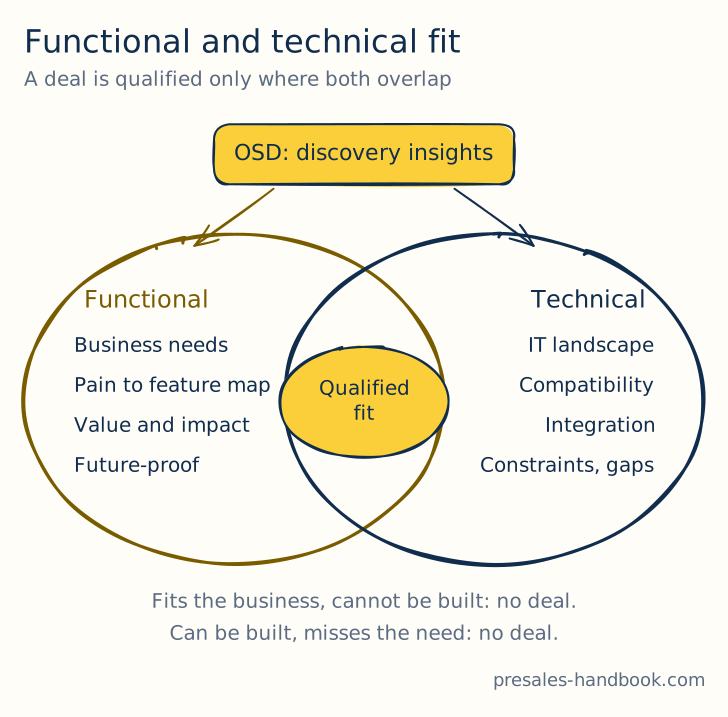
A solution is qualified only where functional and technical fit overlap.
Functional Qualification:
Understanding Business Needs: Look closely at the prospect's operational and strategic challenges to understand their business context and needs in full.
Mapping Solutions to Needs: Match the prospect's pain points to specific features or modules of the solution, so every issue you found is covered.
Assessing Value Proposition (opens in a new tab): Go past matching features. Assess how the solution can change the prospect's operations, improve efficiency and possibly open new revenue streams.
Futureproofing: Make sure the solution can scale and adapt as the prospect's needs and the business environment change.
Technical Qualification:
Understanding Technical Infrastructure: Collect a full picture of the prospect's current technical environment, including software, hardware, data flows and legacy systems.
Compatibility Assessment: Confirm that the solution fits into the prospect's technical environment without causing disruption.
Integration Capabilities: Assess how well the solution integrates with the prospect's existing systems, with consistent data flow and working interplay of functions.
Technical Constraints and Assumptions: Identify any technical limits or requirements that could affect the implementation, so your proposal stays realistic and feasible.
Interplay Between Functional and Technical Qualification:
The two kinds of qualification depend on each other. A solution can meet every business need and still be technically impossible. That helps the client as little as a technically sound solution that misses the business requirements. Both processes repeat, and what you learn in one improves the other. For example, a technical constraint can reveal another functional need, or the other way round.
If you handle both functional and technical qualification well, you can propose solutions that are viable and fit the prospect's specific situation closely. You use resources efficiently, keep client relationships grounded in reality and see a clear path to a successful deal.
Opportunity Review Call (ORC)
The Opportunity Review Call (ORC) is a fixed part of the presales process. Several departments meet to assess opportunities, plan the approach and qualify them. Not every opportunity needs an ORC. It is most useful when you need to discuss technical or functional fit. It also helps when most requirements are met but a critical 10% depend on commitments from other departments. Here is a short overview:
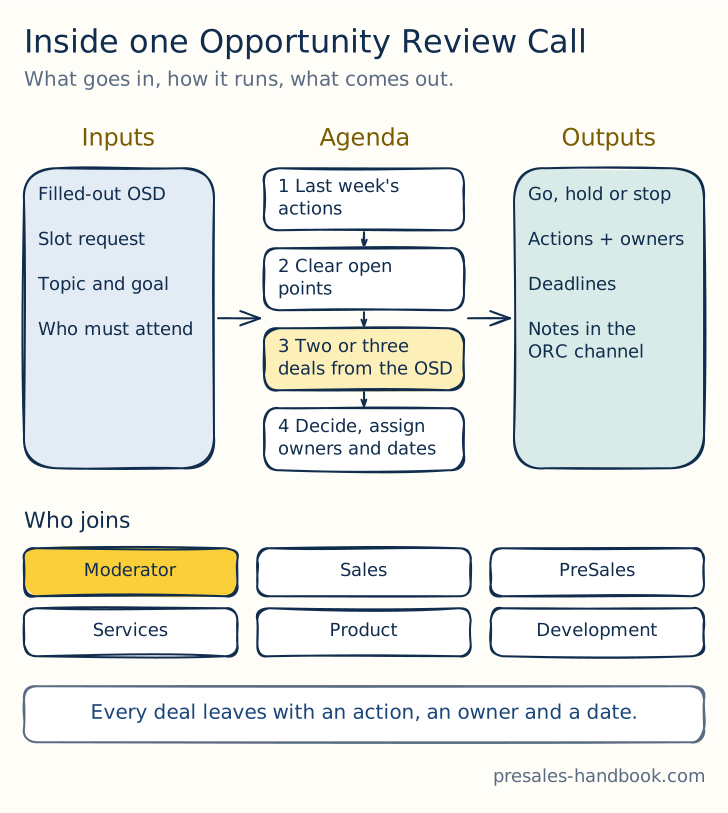
What goes in, how the call runs, what comes out. No deal leaves without an owner.
Purpose of the ORC:
Evaluation and Qualification: The ORC is where opportunities get evaluated and qualified. It decides whether a deal is worth pursuing, plans the approach and identifies likely challenges.
Key Elements for Success:
Consistent Cadence and Diverse Expertise: Regular ORCs make sure new challenges get attention in time. We recommend a weekly call. Sales, PreSales, Professional Services, Product Management and Development all take part, so each opportunity gets a rounded review.
Preparation for the ORC:
Clear Agenda and Pre-reading: Share the agenda and the relevant documents in advance, such as the Opportunity Scoping Document (OSD) (opens in a new tab). Participants can then prepare properly, and the discussion stays focused and productive.
Who to Invite: A named moderator, plus Sales, PreSales, Professional Services, Product Management and Development. Invite the people who can commit resources. If a deal needs a roadmap promise, the product manager has to be in the room.
Running the Call:
A Fixed Order: Start with last week's action items. Clear the open points. Then take two or three deals in depth. The Solution Consultant (opens in a new tab) presents each one from the OSD: the summary, the key issues and the proposed solution. The moderator keeps time and writes down every action.
A Decision per Deal: Every deal leaves with go, hold or stop. Each action gets a named owner and a date. "We should look into that" is not an action.
Tracking and Documentation:
Structured Record-Keeping: Write down the discussions, decisions and action plans from each ORC. This keeps continuity and gives you a reference for current and future opportunities. A dedicated ORC channel in Slack or Microsoft Teams supports ongoing collaboration and knowledge sharing.
Post-ORC Actions:
Translating Insights into Actions: An ORC is only as good as the actions that follow it. After the call, the ORC channel is the place for updates and further discussion. That keeps the opportunity moving and lets you adjust the strategy when needed.
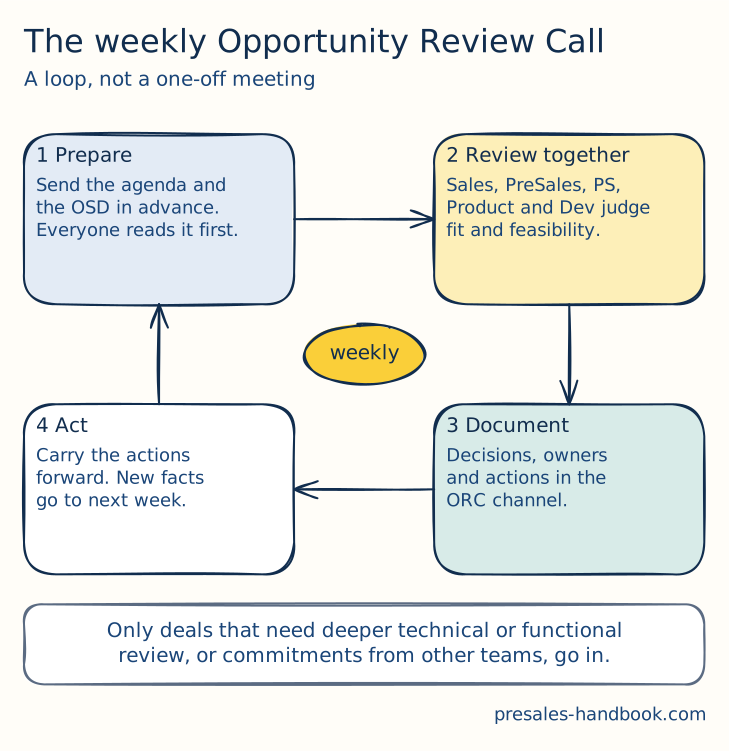
Run every week, the call becomes a qualification gate.
What Next?
After technical and functional qualification, the sale moves into more detailed stages built around the specific client. Each stage brings the proposed solution closer to reality. This is what follows:
Demo Preparation and Execution:
Tailored Demonstrations: Prepare the demo around the client's specific challenges and goals, so the solution's relevance is clear.
Interactive Workshops: Run the demo as an interactive session. The client gives feedback, asks questions and works with you in real time, which confirms the value of the proposed solution.
Proposal Development:
Consolidating Insights: Write a proposal that covers the technical specifications, the integration details and possible customizations. The proposal answers the open challenges and shows that you understand the client's needs.
Resource Estimation: Give a realistic estimate of the resources the implementation needs, including time, people and hardware. This sets accurate expectations and avoids surprises.
Implementation Roadmap:
Clear, Step-by-Step Plan: Build an implementation roadmap with defined milestones, timelines and deliverables. It guides the project and keeps it in line with the client's expectations.
Proof of Concept (PoC):
In some cases, a PoC (opens in a new tab) shows that the solution works in a controlled environment. It settles remaining concerns and confirms the solution's value.
The RFX Process:
The RFX (opens in a new tab) process then sets out the solution's details, costs and other key factors. This builds the client's confidence in the solution and the provider.
PreSales Perspective
In presales, qualifying early and qualifying hard is a deliberate strategy. It makes sure the deal works for both the selling organization and the potential client. The aim is a win-win situation and a lasting partnership, built without doubt or suspicion toward the prospect.
Templates for this chapter
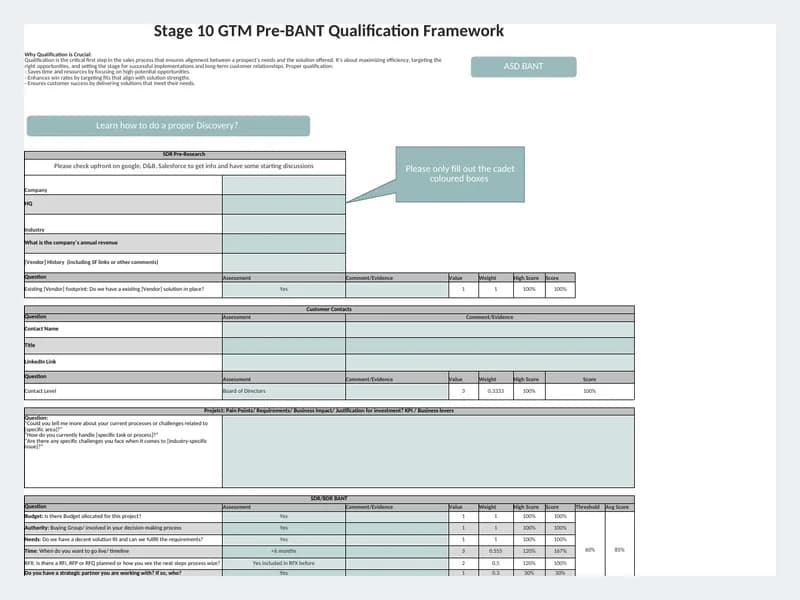 Included with the courseXLSX · 60 KB
Pre-BANT and BANT assessment
Score budget, authority, need and timeline before you invest presales time.
From the blog
- 8 min read
Should You Answer an RFI When the Prospect Goes Silent?
You answered an RFI and heard nothing back. Whether to keep responding to silent prospects, and how to qualify before you invest.
Read more - 6 min read
Missed Your Yearly Quota? Here's How to Bounce Back and Overachieve Next Year
Missed your quota? A step-by-step way to reflect honestly, reset your mindset, revise your goals and plan a stronger year.
Read more - 7 min read
Lessons from the Samurai – Applying Samurai Wisdom to PreSales Mastery
Samurai principles for presales: disciplined preparation, the courage to disqualify, integrity in every deal, focus and adaptability.
Read more
In the course
- Technical Functional Qualification (FTQ)Members only
- Opportunity Review Call (ORC)Members only
- Selling JourneyMembers only