
Field play
Map the buying committee before the second meeting
One friendly champion is a single point of failure. Map the four functions that can veto a deal, name who sits in each and hold three relationships.
Before the second meeting, write down who sits on the buying committee and which of them can veto. Map the four functions that can say no: business, IT, security and finance. Aim for three named relationships. If you cannot name the veto-holder, you do not know the deal.
Key takeaways
- One champion (opens in a new tab) is a single point of failure, however good the relationship feels.
- Four functions can veto: business, IT, security and finance. Put a name next to each.
- Hold three named relationships per committee deal, and make sure one sits in a function that can veto without ever meeting you.
The situation
Say you work a deal with one excellent contact. She answers fast, she likes the product and she tells you the project is on track. Every meeting goes well.
Then the contract reaches a function you never spoke to. Security sends a questionnaire. Finance wants a different number. Nobody told you they were involved, because nobody on your side asked.
Most solution consultants (opens in a new tab) start this way, me included. We build one relationship deeply and call it coverage. It is a single point of failure. The handbook puts the reason plainly: SaaS deals involve many people, and each one buys for different reasons.
Why one champion is not enough
A champion argues for you inside. That is valuable, but it has limits. Your champion can explain your value to her peers. She cannot answer a security reviewer's technical questions, and she may not know what finance will ask. She also has her own priorities and her own standing to protect.
The functions that can veto often never join a demo. Security and finance review papers, not screens. If you never meet them, their first contact with your deal is a document they did not ask for. A concern that could have been a short conversation becomes a formal objection late in the deal.
A map of those people is cheap to draw in week two. Finding them in the last week costs far more.
What to do
Draw the committee before the second meeting. Use one page.
Start with the four veto functions
My working rule is business, IT, security and finance. Write the four on the page and put a name next to each. An empty slot is a finding. It tells you where to ask next.
Learn what each function checks
The buying journey chapter (opens in a new tab) describes six departments. Finance checks the numbers, so show a clear ROI (opens in a new tab) early. IT Security protects the company, so bring your certifications. IT makes it fit, so show how the integration works. Legal checks compliance, so involve them early to speed up approval. Operations runs the daily work and wants demos and pilots. Purchasing negotiates the terms and wants open pricing.
Add the role each person plays
The same chapter lists five deal roles. The member wants daily benefits. The sponsor wants a vision that fits the company's future. The champion argues for you inside and needs data to do it. The detractor needs proof. The gatekeeper guards the procedure and wants documents and protocols in order.
Map every person to a department and to a role. The two are not the same. A finance lead can be your sponsor. An IT architect can be your detractor.
A one-page example
Here is an illustration of what the page can look like. It is not a real deal.
- Business: the head of operations. Role: champion. Contact: weekly.
- IT: the integration architect. Role: detractor, worried about the interface. Contact: one call so far.
- Security: name unknown. Role unknown. Contact: none. Action: ask the champion who runs vendor reviews.
- Finance: the controller. Role: gatekeeper for the budget. Contact: none yet. Action: offer a short value session.
That page shows two relationships, one open veto and one name without contact. You now know what the second meeting is for.
Hold three named relationships
That is my target for each committee deal. At least one of them should sit in a function that can veto without ever meeting you. Security and finance are the usual two.
Ask your champion for the introduction, and give a reason that helps her. Try something like: "Security will review us before signing. If I can answer their questions now, they will not slow your project down later. Who should I speak to?" That makes the introduction a favour to her project, not a request to go around her.
Ask how they buy
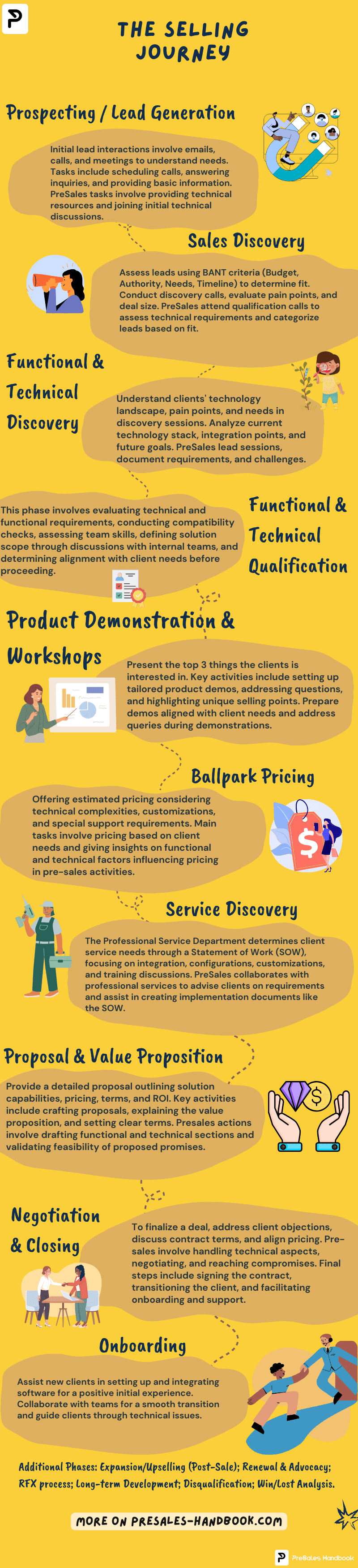
In the first conversation, share how your company sells and ask how the buyer buys. When both sides share their process, you agree on the steps from the start. The handbook shows an example of a client-facing selling journey (opens in a new tab) with the client stakeholders listed next to each step. For more on why both sides need that view, read why buyer and seller both need to understand the journey (opens in a new tab).
Keep the map alive
Put it in your Opportunity Scoping Document (opens in a new tab) next to the notes. Update it after each meeting. A name that was a guess last month may be confirmed now.
Then use the map in your qualification. A deal where you cannot name the veto-holder is a deal you cannot yet forecast. The qualification chapter (opens in a new tab) shows how to weigh that.
What can go wrong
You love your champion too much. A friendly contact feels like safety. It does not replace the other functions. Test it: ask your champion who could stop the deal. If she cannot answer, she may not be as close to the decision as you think.
Going wide hurts the champion. This is the strongest objection to the whole play. Contact her colleagues without her and she may feel bypassed. The fix is to go wide through her, with a reason that serves her goal. Go around her only when she refuses every introduction. Then treat the refusal itself as a warning.
You treat the detractor as an enemy. The detractor needs proof. Talk openly about their concerns and answer with evidence. A detractor you have heard is easier to handle than one you avoid.
Legal and security arrive late. Both can slow a deal at the end. Involve Legal early, and show IT Security your certifications before they ask.
You name people but have no contact. A name on the page is not a relationship. If you have never spoken to the person, mark it as open.
The map becomes a poster. A committee changes during a deal. People join, leave or gain a veto. If you do not update the page, it will mislead you when it matters.
Edge cases
In a smaller company, one person may hold two or three of the four functions. The map still works. You write the same name twice and ask that person each function's questions. In a large enterprise, each function may have its own committee. There you need the name of the person who signs off for that function.
An expansion deal is different from a new logo. You may already know IT and security from the first purchase. Check whether the same people are still in place, because a new security lead means a new review.
The signals
The map is working when you hear about a new stakeholder from your champion before they appear in a meeting. It is failing when a function you have not met sends you a document. For more on how personas pull in different directions, read the complex web of client personas (opens in a new tab).
Try it on your biggest open deal this week. Draw the four functions, write the names and see which boxes stay empty.
Go further
Three ways to go deeper than one article.
- The PreSales Mastery course
The whole method as a video course, with every template included.
- The book on Amazon (opens in a new tab)
The PreSales Handbook, 2nd edition, to read from cover to cover.
- AI PreSales Skills for Claude
A free Claude plugin that applies the handbook's method to your own deal.
About the author
Dr. Johannes Hangl
Presales leader with more than a decade in B2B software. I write about what works in real deals: discovery, demos and the people side of selling.
Related handbook chapters
- Buying JourneySelling journey
- Selling JourneySelling journey
- QualificationPlaybook