

Career and leadership · Chapter 8
PreSales Best Practices: Top 30 Tips for Every Stage
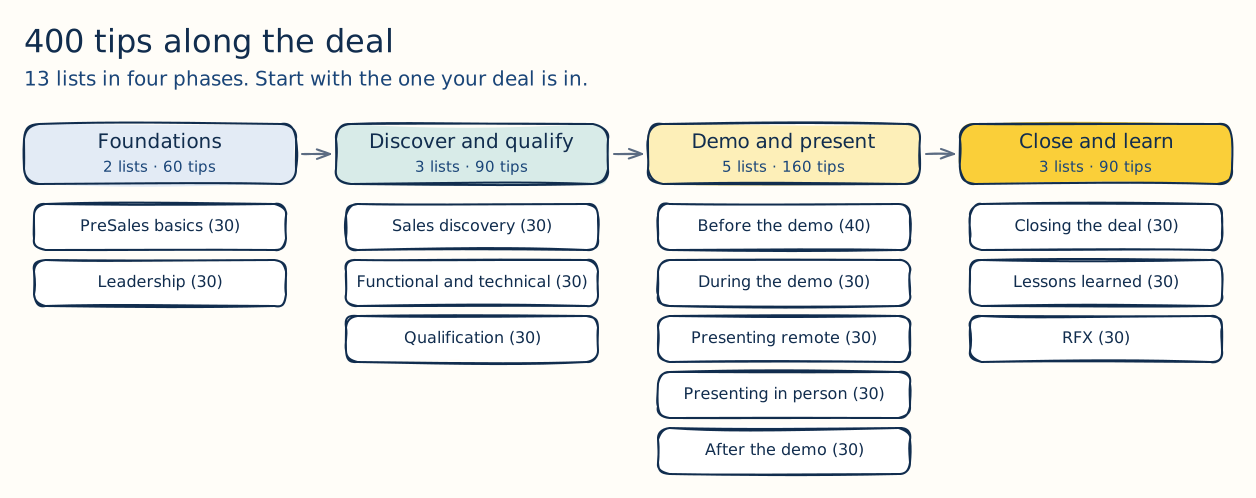
400 presales best practices in 13 lists: discovery, qualification, demos, presenting remote and in person, closing, RFX, lessons learned and leadership.
Presales best practices come down to five principles from The PreSales Handbook: discover, qualify hard, tell the story, listen and stay honest. This chapter puts them into practice with 400 tips. They sit in 13 lists, one for each stage or skill. The lists run from discovery and qualification to the demo, closing, RFX (opens in a new tab) and leadership.
Key takeaways
- Thirteen lists, from discovery and qualification to the demo, closing, RFx and leadership.
- Search all 400 tips, or filter by area and hashtag to find the ones for the stage your deal is in.
- Pick three tips from one list and try them in your next deal. Reading all 400 at once helps nobody.
Top 30 Tips in PreSales
30 · PreSales basics
1.Own the Requirement Analysis: Run a proper functional and technical discovery. Understand the business challenge before anyone talks about product.
- Customer needs and fit
- Tech and integration
2.Document Everything in the OSD: Capture findings, challenges, gaps, business needs and drivers in the OSD. It becomes the single source for the deal.
- Documentation
- Customer needs and fit
3.Qualify Fit and Willingness: Check two things early. Can your solution reach their goals, and is the client willing to invest?
- Customer needs and fit
4.Build Real Rapport: Presales runs on trust. Spend time on the people you will work with for months.
- Trust and rapport
- Time and focus
5.Know Your Product Deeply: Functional and technical depth lets you speak about benefits. It also lets you answer hard questions on the spot.
- Questions and listening
- Tech and integration
6.Turn Complexity into Stories: Turn complicated ideas into simple, interesting narratives. Clients decide on what they understand.
- Storytelling
- Stakeholders and decisions
- Learning and growth
7.Write Proposals with Sales: Draft proposals together with the core sales team. The document shows how the solution meets and exceeds expectations.
- Teamwork
- Documentation
8.Show a Clear Value Roadmap: A proposal needs more than features. Lay out the path from today's problem to the value the client wants.
- ROI and value
- Customer needs and fit
9.Design for This One Client: When the product is complex, shape the configuration around their needs. Never show a generic setup.
- Customer needs and fit
10.Educate as You Sell: Presales is also teaching. The client should understand the value well enough to decide without you.
- Staying in touch
- ROI and value
- Stakeholders and decisions
11.Offer Hands-On Sessions: Deep conversations and hands-on training build real confidence. That confidence shortens the decision.
- Presence and delivery
- Stakeholders and decisions
- Time and focus
12.Tailor Every Demo: Build the demo around what the client asked for. Highlight the strengths that matter to them.
- Customer needs and fit
13.Tell a Story in the Demo: A demo is a narrative, not a feature tour. Show the challenge, the journey and the result.
- Storytelling
14.Be the Voice of the Market: You sit between the product teams and the market. Carry real field feedback back to them.
- Presence and delivery
- Teamwork
- Learning and growth
15.Feed Insights to Product: Share what you learn in live deals regularly. It makes the product more market-ready and more client-focused.
- Staying in touch
- Time and focus
- Learning and growth
16.Answer Concerns Immediately: Your technical knowledge resolves doubts during the call. Fast answers shorten the sales cycle.
- Objections and risk
- Stakeholders and decisions
- Tech and integration
17.Sharpen Your Writing: Proposals and summaries are read by people who never met you. Write clearly and without filler.
- Follow-up
18.Sharpen Your Speaking: Presentations and meetings need the same clarity. Rehearse your key messages until they are yours.
- Preparation
19.Think on Your Feet: Clients raise problems you did not expect. Solving them calmly makes your product look trustworthy.
- Trust and rapport
20.Work Well Internally: Build relationships with sales, product, services and support. Aligned teams deliver better solutions.
- Trust and rapport
- Teamwork
21.Understand the Sales Process: You do not close the deal yourself. Knowing every stage keeps your work aligned with the sales goal.
- Stakeholders and decisions
- Customer needs and fit
22.Give Reassurance Along with Information: Clients need details, demonstrations and reassurance about the value. Plan for all three.
- ROI and value
23.Value Quality Over Speed: A solution that really matches the client's challenges is bought far more often.
- ROI and value
24.Prepare for Every Client Meeting: Review what discovery and the OSD already told you. Clients should not have to repeat themselves.
- Preparation
- Documentation
25.Watch for Hesitation: Interest is growing but the client still hesitates? Offer a hands-on step instead of more slides.
- Visuals and slides
26.Talk About Support After the Sale: Explain what happens once the contract is signed. A support promise often convinces a hesitant buyer.
- Trust and rapport
27.Frame Cost Against Long-Term Benefit: Talk about durability and total cost as well as the price. Buyers weigh both.
- ROI and value
28.Keep Building Expertise: Sales changes constantly. Keep your functional and technical knowledge current.
- Tech and integration
29.Make Your Contribution Visible: Tie your work to the team's conversion goal. Then it does not go unnoticed.
- Customer needs and fit
- Teamwork
30.Remember the Goal: You hold many roles at once. All of them serve one aim: making the sale succeed.
- Customer needs and fit
Top 30 Tips in PreSales Leadership
30 · Leadership
1.Lead with a View Ahead: Watch market trends and shifts before they hit your deals. Set a direction that fits the company's long-term goals, so the team is ready when things change.
- Customer needs and fit
- Competition
- Teamwork
2.Develop Your Team: Invest in every person's growth. Use targeted training and send people to the workshops that sharpen the skills they need next.
- Teamwork
- Learning and growth
3.Champion Collaboration: Build teamwork across departments. Regular meetings with sales, product and services keep everyone pulling in the same direction.
- Teamwork
- Stakeholders and decisions
4.Reward Curiosity: Make learning part of the job. Keep an eye on new tools and methods that make the team faster or better.
- Learning and growth
- Questions and listening
- Tech and integration
5.Communicate Clearly: Say the same thing, clearly, to every stakeholder. Team meeting, executive briefing or client call: everyone should leave with the same picture.
- Stakeholders and decisions
- Teamwork
- Visuals and slides
6.Resolve Conflicts Early: Step in when departments clash. Name the problem and mediate before it poisons the working climate.
- Teamwork
7.Tailor the Training: Build training around the real gaps and challenges of your team. Generic courses rarely stick. Training that fits does.
- Learning and growth
- Customer needs and fit
- Teamwork
8.Assign Work by Strength: Know what each person does best. Staff deals by skill and business priority. Who happens to be free is a poor reason.
- Teamwork
9.Stay Close to Clients: Join client calls yourself. Direct feedback tells you more about your team's work than any report.
- Teamwork
- Learning and growth
10.Grow the Next Leaders: Spot leadership talent early. Offer mentoring and stretch tasks so the team does not depend on you alone.
- Teamwork
- Learning and growth
11.Give Real Autonomy: Delegate decisions as well as tasks. People who own their scope grow faster and take more responsibility.
- Stakeholders and decisions
- Teamwork
12.Make Room for New Ideas: Ask the team for ideas that save time or win clients. Make it safe to try something and fail.
- Learning and growth
- Questions and listening
- Teamwork
13.Put the Customer First: Plan presales work around customer outcomes. That focus drives growth and your reputation in the market.
- Customer needs and fit
- Time and focus
14.Decide with Data: Use numbers on win rates, deal time and demo results to guide your choices. Data beats gut feeling in a budget talk.
- ROI and value
- Stakeholders and decisions
- Time and focus
15.Protect Work-Life Balance: Watch for the early signs of burnout. Act before your best people run empty.
- Objections and risk
16.Build a Feedback Culture: Ask the team for feedback on a regular basis and act on it. That improves your leadership and keeps people on board.
- Learning and growth
- Trust and rapport
- Questions and listening
17.Build Processes That Scale: Design ways of working that still hold when the team doubles. Growth should not cost quality.
- ROI and value
- Teamwork
18.Educate Your Clients: Create sessions and material that help clients understand the product. Clients who understand it use it and stay.
- Staying in touch
19.Know Your Industry: Follow industry news and competitor moves. That knowledge helps your team position the solution in every deal.
- Competition
- Teamwork
20.Celebrate Wins: Recognise successes, big and small. Celebration boosts morale and shows the team which behaviour you want more of.
- Teamwork
21.Manage Risk: Spot risks in deals and in the market early. Have a plan ready, so the team is not caught off guard.
- Objections and risk
- Teamwork
22.Work in Short Cycles: Borrow from agile. Short sprints and regular retrospectives help the team adapt and improve step by step.
- Time and focus
- Learning and growth
- Teamwork
23.Keep the Team Digitally Fit: Make sure everyone masters the tools that speed up the work. Short training on new tools keeps the team current.
- Tech and integration
- Teamwork
- Customer needs and fit
24.Build a Knowledge Base: Keep case studies, templates and best practices in one place everyone can find. It saves hours and keeps quality even.
- Documentation
- Preparation
- Trust and rapport
25.Engage the Executives: Meet the C-level regularly. Align presales with the company's goals, so your team's work visibly moves the business.
- Stakeholders and decisions
- Customer needs and fit
- Teamwork
26.Think Beyond Standard Solutions: Train the team to shape offers around each client's needs. A tailored answer wins more loyalty than a standard one.
- Customer needs and fit
- Trust and rapport
- Teamwork
27.Train Across Functions: Let presales people learn how other departments work. Understanding each other makes cooperation easier.
- Teamwork
- Learning and growth
28.Sharpen Negotiation Skills: Train the team to negotiate. Practise different buying personas and tough scenarios before they happen in a real deal.
- Objections and risk
- Customer needs and fit
- Stakeholders and decisions
29.Check How You Use Your People: Review regularly where the team's time goes. Move capacity to the deals and tasks that matter most.
- Time and focus
- Teamwork
30.Lead by Example: Show the integrity, commitment and resilience you expect. Your team copies what you do.
- Storytelling
- Trust and rapport
- Teamwork
Top 30 Tips in Sales Discovery
30 · Sales discovery
1.Start with Personal Connection: Begin your discovery conversation with personal questions that relate to the individual's role and their journey to their current position. This helps to establish rapport and gather insights into their perspectives and influence within their organization.
- Stakeholders and decisions
- Trust and rapport
- Questions and listening
2.Understand the Company and Team: Ask about the company's structure, the team's size, roles, and experience levels. Understanding the company's demographics can reveal how decisions are made and who the key stakeholders might be.
- Teamwork
- Stakeholders and decisions
- Questions and listening
3.Explore Workflows and Processes: Look into the existing workflows and processes to understand how they are managed. Identify inefficiencies or pain points that your solution might address. Keep the initial conversation high-level, focusing on gathering basic workflow "vitals" before diving deeper.
- Customer needs and fit
- Time and focus
4.Assess the Technical Environment: Inquire about the prospect's current technology infrastructure and future plans. This helps in aligning your solution's technical capabilities with their technology roadmap and existing systems.
- Tech and integration
- Customer needs and fit
5.Identify Major Pains and Related Pains: Encourage the prospect to describe their current major challenges and processes. Use tools like diagrams or whiteboards to visualize these processes, which can help uncover the primary pains and related secondary issues.
- Customer needs and fit
- Visuals and slides
- Tech and integration
6.Quantify Impact and Vision Reengineering: Discuss the measurable impacts of the existing challenges and explore the prospect's vision for a solution. This often includes understanding the financial and operational gains from addressing their pain points.
- Customer needs and fit
- ROI and value
7.Explore the Extended Environment: Go beyond immediate needs to understand the broader business environment, including adjacent and impacted areas. This can open up discussions about additional value your solution could provide.
- Customer needs and fit
- ROI and value
8.Discuss Cultural and Organizational Uniqueness: Recognize what makes the prospect's company unique. Consider how these unique traits might influence the adoption and success of your solution.
- Trust and rapport
9.Evaluate the Consequences of Inaction: Discuss what happens if no solution is implemented. This helps in assessing the urgency and importance of solving the identified problems, guiding the prospect to recognize the need for a timely decision.
- Time and focus
- Stakeholders and decisions
10.Create a Mutual Action Plan: Conclude the discovery phase with a clear plan that outlines next steps. This might include scheduling a detailed demonstration or further stakeholder discussions. This plan should reflect everything learned during discovery and align with the prospect's purchasing process.
- Follow-up
- Stakeholders and decisions
- Learning and growth
11.Confirm Budget Early: Clarify budget constraints early in the discussion to tailor the conversation around solutions that fit within the prospect's financial parameters. Understanding the budget helps in focusing on feasible solutions. (BANT)
- ROI and value
- Customer needs and fit
- Time and focus
12.Identify Decision Makers: Identify all key stakeholders and decision-makers early in the process. This helps ensure that all necessary parties are involved from the beginning and can speed up the decision-making process.
- Stakeholders and decisions
13.Assess Purchase Readiness: Determine how soon the prospect needs to implement a solution and what events might trigger the purchase. This helps in timing your proposal appropriately.
- Stakeholders and decisions
- Customer needs and fit
- Staying in touch
14.Explore Previous Solutions: Inquire about past solutions the prospect has used for similar problems. This can reveal what has worked or hasn't and how your solution could offer improvements.
- Learning and growth
15.Understand Compliance and Regulations: Discuss any compliance issues or regulatory requirements affecting the prospect. This ensures your solution meets all necessary criteria and avoids potential roadblocks.
- Tech and integration
- Customer needs and fit
16.Ask Open-ended Questions: Use open-ended questions to encourage detailed responses. This can provide deeper insights into the prospect's challenges and needs.
- Questions and listening
- Customer needs and fit
- Staying in touch
17.Use Social Proof: Mention how similar companies have successfully implemented your solutions. Case studies or testimonials can be persuasive in demonstrating the effectiveness of your solution.
- Trust and rapport
18.Check Competitor Influence: Find out if the prospect is considering competitors' solutions. Understanding their evaluation criteria and preferences can help tailor your pitch to highlight unique advantages.
- Competition
- Customer needs and fit
19.Seek Referrals within the Organization: Ask for referrals to other departments within the prospect's organization that might benefit from your solution. This can expand your footprint and create multi-threaded relationships.
- Questions and listening
- Trust and rapport
- Teamwork
20.Summarize and Confirm Understanding: At the end of your discovery call, summarize key points and confirm your understanding with the prospect. This helps ensure alignment and addresses any misunderstandings early on.
- Follow-up
21.Prioritize Flexibility in Solutions: Highlight the adaptability of your solutions during discussions. Emphasize how they can be tailored to meet specific needs or scaled as the prospect's business grows.
- Customer needs and fit
- Time and focus
22.Emphasize the Impact of Delay: Discuss the potential costs and lost opportunities that could result from delaying the implementation of a solution. This can help create a sense of urgency and prioritize your solution in the prospect's considerations.
- Time and focus
- ROI and value
23.Detail the Implementation Process: Provide a clear and concise roadmap of the implementation process. This includes timelines, key milestones, and what is required from the prospect's team, helping them visualize the path forward.
- Time and focus
- Teamwork
- Visuals and slides
24.Focus on Return on Investment (ROI): Prepare to discuss and demonstrate the ROI of your solution. Use data and analytics to make a compelling case for the financial benefits of your product or service.
- ROI and value
- Time and focus
- Preparation
25.Use Visual Aids: Employ diagrams, flowcharts, or slides to visually explain how your solutions work or how they integrate with existing systems. Visuals can aid comprehension and retention of complex information.
- Visuals and slides
- Tech and integration
26.Handle Objections Gracefully: Be prepared to address and overcome objections. Understand common concerns related to your product and have responses ready that reassure and educate the prospect.
- Objections and risk
- Preparation
- Staying in touch
27.Monitor Prospect Engagement: Pay attention to the prospect's engagement level during discussions. Are they asking questions, and do they seem really interested? Adjust your approach based on their cues to keep them engaged.
- Questions and listening
28.Facilitate Internal Consensus: Offer to provide materials or meetings that can help the prospect communicate the value of your solution internally. In complex B2B deals, helping them sell internally often decides the outcome.
- ROI and value
- Stakeholders and decisions
29.Clarify Next Steps Clearly: Always end each interaction with a clear agreement on next steps. This could be a follow-up meeting, a call to discuss details with other team members, or a deadline for a proposal submission.
- Follow-up
- Teamwork
- Time and focus
30.Use Technology: Use CRM tools to track and manage discovery insights and follow-ups effectively. Tools like these can help personalize the customer experience and ensure no details are missed during the sales process.
- Tech and integration
- Stakeholders and decisions
- Follow-up
Top 30 Tips for Functional & Technical Discovery
30 · Functional and technical discovery
1.Understand the Background: Start by understanding the prospect's business, their position in the industry, and their business goals. Use the BANT form and discuss the initial meeting with the prospect.
- Customer needs and fit
2.Explore the Technical Environment: Look into the prospect's current technical infrastructure, including existing solutions, tech stack, and future plans. This will help in understanding how your solution can integrate or replace existing systems. Use a structured Questionnaire or the OSD to understand what is required.
- Tech and integration
- Customer needs and fit
- Documentation
3.Identify Key Pain Points: Identify the major challenges the prospect is facing with their current setup. Understand the primary pain points and the related secondary issues that your solution could address. Use a structured Questionnaire or the OSD to understand what is required.
- Customer needs and fit
- Documentation
- Questions and listening
4.Quantify the Impact: Help the prospect quantify the impact of their pain points in terms of cost, productivity, and operational efficiency. This quantification can aid in creating a compelling case for your solution.
- ROI and value
- Customer needs and fit
5.Establish Solution Fit: Discuss specific capabilities of your solution that match the prospect's needs. This directly ties the discovery conversation to potential outcomes and benefits that resonate with the prospect.
- Customer needs and fit
6.Vision Reengineering: Encourage the prospect to envision a future state with your solution in place. Discuss the broader impact on their workflows and potential for reengineering their business processes for better results.
- Customer needs and fit
7.Evaluate Extended Environment: Go beyond immediate needs and explore adjacent and impacted areas within the prospect's business that could benefit from your solution. This broader evaluation can uncover additional opportunities for your offering.
- Customer needs and fit
8.Discuss Implementation and Adoption: Talk about the implementation process, expected challenges, and how your team would support the transition. Also, discuss the adoption process within their organization to ensure the solution is successfully embraced post-deployment.
- Teamwork
9.Create a Mutual Action Plan: Develop a plan that outlines the next steps both parties need to take following the discovery session. This should include timelines, key milestones, and responsibilities to maintain momentum towards a decision.
- Follow-up
- Time and focus
- Stakeholders and decisions
10.Document and Share Discoveries: Summarize the discovery findings and share them with your prospect to confirm understanding and alignment. This documentation can serve as a basis for all subsequent steps. It also ensures that both parties are in agreement on the key issues and proposed solutions.
- Documentation
- Follow-up
11.Focus on Business Outcomes: Frame your technical discovery in terms of business outcomes that matter to the prospect. Understand the key performance indicators (KPIs) they care about, and how your solution can impact those metrics positively.
- Time and focus
- Tech and integration
12.Use Cases and Scenarios: Ask the prospect to describe specific use cases or scenarios where their current systems are falling short. This helps in tailoring your solution presentation to address real-world applications that the prospect will find relevant and compelling.
- Customer needs and fit
- Storytelling
- Questions and listening
13.Stakeholder Mapping: Identify all key stakeholders involved in the buying process. Understand their roles, influence, and individual pain points. This will help tailor conversations and demonstrations to address the concerns of each stakeholder.
- Stakeholders and decisions
- Customer needs and fit
- Objections and risk
14.Competitive Landscape Awareness: During the OSD and ORC, discuss the competitive landscape. Understand the solutions the prospect is currently considering and how they perceive your solution in comparison. This insight can guide how you position your solution more effectively.
- Competition
- Documentation
- Staying in touch
15.Security and Compliance: Address security and compliance issues that are critical to the prospect. Demonstrating an understanding of these aspects and how your solution meets or exceeds industry standards can be a strong differentiator.
- Tech and integration
- Competition
16.Integration Points: Explore potential integration points with the prospect's existing systems. Understanding these can help in assessing the feasibility of integration and the scope of work involved, which often decide the deal.
- Tech and integration
- Stakeholders and decisions
17.Technical Proof Points: Provide technical proof points, such as performance metrics, scalability evidence, and reliability stats. These reassure the prospect that your solution is reliable. Use these points during ORC to substantiate your claims.
- Tech and integration
18.Request a Current System Walkthrough: Ask for a walkthrough of their current systems and processes. This can provide deeper insights into their operations and help identify unseen opportunities where your solution could add value.
- ROI and value
- Questions and listening
- Staying in touch
19.Timeline and Roadmap Discussions: Discuss realistic timelines for implementation and any dependencies that might affect these timelines. This should be aligned during the ORC to set appropriate expectations and planning.
- Time and focus
20.Follow-up Strategy: Develop a clear follow-up strategy post-ORC. Determine who will be involved in these follow-ups, the topics to be addressed, and the medium of communication. This ensures continuity and keeps the project moving forward smoothly.
- Follow-up
21.Document Details Thoroughly: Ensure all technical details, system requirements, and discussions are carefully documented in the OSD. This allows a full review during the ORC and ensures nothing is missed or misunderstood.
- Documentation
- Customer needs and fit
- Tech and integration
22.Technical Challenges Identification: Explicitly ask about any technical challenges or limitations the prospect has experienced. This information should be revisited during the ORC to confirm that your proposed solutions effectively address these challenges.
- Tech and integration
- Questions and listening
23.Customization Needs: Determine the level of customization required for the prospect to integrate and use your solution effectively. Customization capabilities can often be a deciding factor, so make sure to discuss this during the ORC.
- Customer needs and fit
- Tech and integration
24.Future Scalability: Discuss current needs and future scalability during the OSD. This foresight can be critically assessed during the ORC to ensure the solution can grow with the prospect's business.
- Tech and integration
- Documentation
- Customer needs and fit
25.Data Migration Strategies: Identify the needs and strategies for data migration if applicable. Understanding the scope of data migration early on helps in planning and executing a smoother transition, which should be detailed during the ORC.
- Tech and integration
- Customer needs and fit
26.Risk Management: Address potential risks and their management strategies. Discussing risk management during the OSD and reviewing these plans during the ORC can build confidence. This trust extends to the feasibility and reliability of the solution.
- Objections and risk
- Documentation
- Trust and rapport
27.Demonstrate Thought Leadership: Use the OSD and ORC to share insights and best practices related to the prospect's industry and technical needs. This positions you as a thought leader and adds value to the relationship.
- Documentation
- ROI and value
- Customer needs and fit
28.Feedback Loops: Establish a mechanism for ongoing feedback throughout the discovery and implementation phases. This should be agreed upon during the ORC to ensure continuous improvement and satisfaction.
- Learning and growth
29.Technical Training and Support: Discuss the training and support that will be available post-implementation. Ensuring that the prospect feels supported in the OSD and confirming the details in the ORC can be important in the decision-making process.
- Learning and growth
- Tech and integration
- Documentation
30.ROI Discussion: Clearly articulate the expected return on investment (ROI) during both the OSD and ORC. Providing concrete figures and timelines can help justify the investment to stakeholders and speed up the decision-making process.
- ROI and value
- Stakeholders and decisions
- Documentation
Top 30 Tips for Qualification
30 · Qualification
1.Qualify Early, Qualify Hard: Qualification decides where your time goes. Do it at the start, before any demo.
- Stakeholders and decisions
- Time and focus
2.Treat It as Strategy: Qualifying hard confirms that both sides can succeed. The client should not read it as doubt.
- Objections and risk
3.Aim for a Win on Both Sides: The goal is a situation where both parties win. And a partnership that lasts.
- Customer needs and fit
4.Check Client Readiness: Use the BANT framework for budget, authority, need and timing. Commit resources only after that.
- ROI and value
- Staying in touch
5.Accept That Not Every Deal Fits: Your solution solves specific challenges. Some clients have different ones.
- Customer needs and fit
6.Check Fit First: Do an early fit check before you enter a sales process. Without it, you lose direction fast.
- Customer needs and fit
- Stakeholders and decisions
7.Match Needs Against Real Capability: Hold the client's true needs against what your product actually does today.
- Customer needs and fit
8.Protect Your Resources: Stop early when the effort goes in a direction unlikely to bear fruit.
- Staying in touch
9.Find Out Who Decides: Qualification means knowing who inside the client organisation may actually say yes.
- Stakeholders and decisions
10.Engage Stakeholders Early: Early contact with decision makers clarifies the process. It also exposes bottlenecks before they hurt.
- Stakeholders and decisions
11.Aim at the People Who Matter: Once you know who decides, direct your conversations and presentations at the people with a say.
- Stakeholders and decisions
12.Set Expectations at the Start: Clear expectations carry the relationship. Unclear ones create misalignment.
- Trust and rapport
13.Agree on Timelines and Deliverables: Agree what will be delivered and when. Use words both sides can repeat back.
- Time and focus
14.Agree on Costs and Support: Clarify price and the support structure early, so no unwelcome surprises come later.
- ROI and value
15.Keep the Dialogue Transparent: An honest conversation at the beginning keeps both sides in sync as the deal moves.
- Trust and rapport
16.Use the OSD as a Sieve: The OSD refines many possibilities into the ones that fit the needs and the constraints.
- Documentation
- Customer needs and fit
17.Qualify Functionally: Check that the solution really addresses the documented inefficiencies and pain points.
- Customer needs and fit
- Documentation
18.Map Pains to Features: Link every documented challenge to a feature or module. Gaps become visible at once.
- Customer needs and fit
- Documentation
19.Balance Today and Tomorrow: A qualified solution fixes current issues and still carries the client's future goals.
- Customer needs and fit
20.Assess the Value Proposition: Go beyond feature matching. Ask how the solution changes their operations and efficiency.
- ROI and value
- Questions and listening
21.Qualify Technically: Validate the solution against the client's IT systems and architecture before you promise anything.
- Tech and integration
22.Confirm Compatibility: Check that the solution fits the existing technical environment without disrupting operations.
- Tech and integration
- Customer needs and fit
23.Check Integration Capability: Look at the data flow between systems. Integration effort is often the deciding factor.
- Tech and integration
- Staying in touch
24.Name Technical Bottlenecks: Identify legacy constraints and the places that need a deliberate change. Do not hide them.
- Tech and integration
25.Write Down Assumptions and Gaps: The assumptions and gaps section of the OSD keeps the proposal realistic.
- Documentation
26.Futureproof the Solution: Ask whether the solution scales and adapts as the client's needs change.
- Customer needs and fit
- Questions and listening
27.Treat Both Qualifications as One: A perfect business fit without technical feasibility is as useless as the reverse.
- Customer needs and fit
- Tech and integration
28.Run an Opportunity Review Call: Bring the opportunity into an ORC when functional or technical fit still needs a cross-team decision.
- Customer needs and fit
- Stakeholders and decisions
- Tech and integration
29.Bring Mixed Expertise to the ORC: Sales, PreSales, Professional Services, Product Management and Development each see different risks.
- Teamwork
- Objections and risk
- Learning and growth
30.Document Decisions and Act on Them: Record the discussion, the decisions and the actions. An ORC is worth only its follow-through.
- Stakeholders and decisions
- Documentation
Top 40 Tips Before the Demo
40 · Before the demo
1.Understanding Customer Pain Points and Needs: Ensure that you fully understand the customer's key pain points and requirements. This involves a close look at their workflows, pain points, and the impact of these issues on their operations. If your solution does not address these needs effectively, the deal might not be viable.
- Customer needs and fit
2.Budget Alignment: Confirm that the prospect has a budget allocated for the solution. No budget often means no project, and spending time on deals where the budget is uncertain can be inefficient.
- ROI and value
- Time and focus
3.Decision-Maker Engagement: Ensure that you are in contact with the actual decision-makers. Deals that lack engagement from key stakeholders typically have a lower chance of closing.
- Stakeholders and decisions
4.Solution Fit: Evaluate how well your product or service fits with the prospect's existing technology stack and their future plans. A good fit leads to smoother integration and happier users, which makes the deal more likely.
- Customer needs and fit
- Tech and integration
5.Competitive Advantage: Determine if your solution provides a distinct competitive advantage over alternatives the customer might be considering. Know your unique selling points and how they match the customer's needs.
- Competition
- Customer needs and fit
6.Implementation Feasibility: Consider the ease and feasibility of implementation and the prospect's ability to adopt and integrate the new system. Deals that require extensive effort to implement or face significant resistance from end-users are less likely to succeed.
- Stakeholders and decisions
- Tech and integration
- Objections and risk
7.Customer's Buying Process: Understand the prospect's buying process, including their timing requirements, internal approvals, and any potential roadblocks. Misalignment in the sales cycle or overly complex procurement processes can be a disqualifier.
- Stakeholders and decisions
- Customer needs and fit
8.Critical Business Impact: Assess whether your solution impacts critical business operations and how significant this impact is. Solutions that have a clear and quantifiable impact on the prospect's business outcomes are more compelling.
- Customer needs and fit
9.Future Potential: Consider the future potential for upselling and cross-selling additional services or modules. Accounts with growth potential offer more value over time.
- ROI and value
- Time and focus
10.Cultural Fit: Ensure that there is a good cultural fit between your company and the prospect. This includes shared values and a mutual understanding of business operations, which can significantly influence the long-term success of the relationship.
- Trust and rapport
- Customer needs and fit
- ROI and value
11.Clear ROI Demonstration: Ensure you can demonstrate a clear return on investment that aligns with the prospect's financial goals. A strong, quantifiable ROI can make the decision easier for a prospect.
- ROI and value
- Customer needs and fit
- Stakeholders and decisions
12.Alignment with Strategic Goals: Understand how your solution aligns with the prospect's long-term strategic goals. Deals that are aligned with the core strategic direction of a company are more likely to gain internal support.
- Customer needs and fit
13.Regulatory Compliance and Risk: Evaluate whether your solution helps the prospect comply with relevant regulations or reduces significant business risks. This can often turn a nice-to-have solution into a must-have.
- Tech and integration
- Objections and risk
14.Market Position and Stability: Assess the stability and market position of the prospect's company. Engaging with companies that have a stable market position or are in growth phases can lead to longer and more profitable relationships.
- Trust and rapport
15.Technological Scalability: Check if your solution can scale with the prospect's growth expectations without requiring significant additional investments. Scalability can be a critical factor in the decision-making process.
- Tech and integration
- Stakeholders and decisions
16.Vendor Support and Service Levels: Highlight the support and service levels your company offers. Strong post-sale support can differentiate your solution and help secure the deal.
- Competition
17.Feedback from Current Users: Share testimonials and case studies from current users that demonstrate satisfaction and the real-world benefits of your solution. Positive feedback builds credibility and trust.
- Trust and rapport
- Learning and growth
- Storytelling
18.Trial and Proof of Concept: Offer a trial or proof of concept to demonstrate the effectiveness of your solution in the prospect's environment. This can help mitigate perceived risks associated with the purchase.
- Objections and risk
- Customer needs and fit
- Stakeholders and decisions
19.Compatibility and Integrations: Ensure that your solution is compatible with the prospect's existing systems and can easily integrate with other tools they are using. Smooth integration is often a key decision factor.
- Tech and integration
- Stakeholders and decisions
20.Visibility and Reporting Features: Demonstrate how your solution can provide better visibility and reporting capabilities. Better analytics and reporting give insights for business decisions, which makes your solution more attractive.
- Tech and integration
- Stakeholders and decisions
- Staying in touch
21.Customer Success Track Record: Highlight examples where your solution has significantly contributed to customer success. Prospects are more likely to commit when they see proven outcomes.
- Documentation
- Storytelling
22.Regulatory Updates and Compliance: If applicable, emphasize how your solution stays updated with regulatory changes. This provides value by keeping the client compliant without additional effort on their part.
- Tech and integration
- ROI and value
23.Flexibility of Your Offering: Demonstrate the flexibility of your solution to adapt to the prospect's changing needs. Flexibility matters most for companies in fast-changing industries.
- Customer needs and fit
24.Ease of Use: Show the user-friendliness of your solution. A system that is easy to use can lead to quicker adoption and lower training costs.
- ROI and value
- Learning and growth
25.Innovation and Continuous Improvement: Share your roadmap for future updates and innovations. Prospects looking for a long-term solution prefer vendors who invest in ongoing development to keep their offerings competitive.
- Learning and growth
- Competition
26.Security Features: Security is critical in all IT solutions. Detail the security measures and data protection protocols your solution employs, reassuring prospects about the safety of their data.
- Tech and integration
27.Environmental and Social Governance (ESG) Compatibility: If your solution or company operations support ESG principles, highlight these. Many organizations now prioritize sustainability and ethical operations in their purchasing decisions.
- Customer needs and fit
- Tech and integration
- Stakeholders and decisions
28.Customer Service and Technical Support: Detail the availability and quality of customer support. Good customer service can be a deal clincher, especially for complex solutions.
- Tech and integration
29.Vendor Stability and Reliability: Provide information on your company's financial health and stability. A stable vendor reassures prospects about ongoing service and support.
- ROI and value
30.Cultural Compatibility: Assess the cultural fit between your team and the prospect's team. Similar work cultures can lead to smoother implementations and better long-term relationships.
- Trust and rapport
- Tech and integration
- Teamwork
31.Stakeholder Alignment: Ensure all key stakeholders, including end-users and decision-makers, see the value of your solution. Their buy-in is needed for smooth adoption and a successful implementation.
- Stakeholders and decisions
- ROI and value
32.Technical Compatibility: Confirm that the technical requirements of your SaaS solution (such as specific integrations or platforms) are compatible with the prospect's current IT infrastructure.
- Tech and integration
- Customer needs and fit
33.Financial Health of Prospect: Investigate the prospect's financial health to assess their ability to sustain the subscription model over the long term. Financially stable prospects are less likely to churn.
- ROI and value
34.Training and Onboarding: Offer thorough training and onboarding. These services can help alleviate concerns about the learning curve associated with adopting new software.
- Learning and growth
- Objections and risk
35.Performance Metrics: Demonstrate how your solution tracks and improves key performance indicators (KPIs). Prospects want to see how your tool can concretely impact their business.
- Learning and growth
36.Data Migration Capabilities: If switching from another system, show how your solution can assist with data migration. A smooth transition process can be a significant selling point.
- Tech and integration
37.Customization Options: Discuss the customization options available with your solution. Prospects often have specific needs that require tailored features or functionalities.
- Customer needs and fit
38.Long-term Cost Benefits: Outline the long-term cost savings of your solution, considering both direct and indirect costs. Highlighting the total cost of ownership can help justify the investment.
- ROI and value
39.Third-party Reviews and Ratings: Use positive third-party reviews and ratings to build credibility. Objective assessments from reputable sources can influence decision-making.
- Stakeholders and decisions
- Trust and rapport
40.Exit Strategy and Data Ownership: Clarify terms related to contract termination, data ownership, and data retrieval processes. Prospects will be reassured knowing they can exit the contract without losing their data.
- Tech and integration
Top 30 Tips while Demo
30 · During the demo
1.Focus on Key Features and Benefits: Start by clearly stating the most important features and benefits of your software. Avoid going into unnecessary details and sidestep features that aren't relevant to your audience's needs.
- Time and focus
- Customer needs and fit
- Stakeholders and decisions
2.Use Real-World Examples: Demonstrate the software's capabilities through scenarios and examples that relate directly to the audience's industry or business. Show the practical applications and the expected results to make it more relatable.
- Storytelling
- Customer needs and fit
- Stakeholders and decisions
3.Integrate Storytelling: Weave a narrative throughout your demo. Use storytelling to make your presentation memorable and to help the audience better understand and relate to the software's potential impact on their work.
- Storytelling
- Tech and integration
- Stakeholders and decisions
4.Highlight Comparison Points: Briefly compare your software to other common solutions the audience might be familiar with, emphasizing how your software is different or superior.
- Stakeholders and decisions
- Time and focus
5.Use Visual Aids: Employ diagrams, infographics, and other visual tools to break up the monotony and simplify complex information. This makes it easier for the audience to grasp.
- Visuals and slides
- Stakeholders and decisions
- Tech and integration
6.Show the Return on Investment (ROI): Quantify the return on investment wherever possible using clear numbers and statistics. This helps in demonstrating the tangible benefits and aids stakeholders in justifying the investment.
- ROI and value
- Stakeholders and decisions
7.Avoid Information Overload: Stick to necessary information. Leave the audience curious and wanting more. Too much data overwhelms them.
- Stakeholders and decisions
- Questions and listening
8.Encourage Interaction: Engage your audience by incorporating interaction through questions, feedback, or live participation. This involvement can increase attention and retention.
- Stakeholders and decisions
- Questions and listening
- Learning and growth
9.Remain Adaptable: Be prepared to alter your demo focus based on audience interest or questions that arise. Flexibility can lead to a more personalized and relevant presentation.
- Stakeholders and decisions
- Customer needs and fit
- Questions and listening
10.Emphasize Benefits Over Features: While it's important to discuss what the software can do, focus more on how these capabilities solve problems or add value. Align this with the audience's specific needs and pain points.
- Customer needs and fit
- ROI and value
- Stakeholders and decisions
11.Maintain a Positive Attitude: When faced with skepticism or objections, remain positive and focus on reiterating the value and benefits your software offers.
- ROI and value
- Objections and risk
- Time and focus
12.Be Prepared for Technical Questions: Have a deep understanding of the technical aspects of your software to confidently address any detailed inquiries from the audience.
- Tech and integration
- Questions and listening
- Preparation
13.Use Personalization: Tailor the demo to reflect the specific roles or pain points of the audience members. This personal touch can make the demo more relevant and engaging for each participant.
- Stakeholders and decisions
- Customer needs and fit
- Learning and growth
14.Implement Breaks Strategically: Keep your audience fresh and attentive by scheduling short breaks during longer demos, ideally every 45 minutes.
- Customer needs and fit
- Stakeholders and decisions
- Time and focus
15.Use an Interactive Demo Environment: Allow the audience to experience the software hands-on through a controlled environment. They can interact with its features under your guidance.
- Customer needs and fit
- Stakeholders and decisions
16.Use Multimedia Elements: Incorporate videos, animations, or interactive elements that can explain complex features more clearly than text or speech.
- Visuals and slides
17.Follow Up Post-Demo: After the demo, send a summary of what was covered, answer any outstanding questions, and provide next steps or additional resources. This follow-up can reinforce the value of the demo and keep your audience engaged.
- Follow-up
- ROI and value
- Stakeholders and decisions
18.Prepare Backup Plans: Have contingencies for technical issues, such as problems with the demo software or presentation tools. This ensures you can still deliver an impactful presentation.
- Preparation
- Tech and integration
19.Show Customer Testimonials: Share success stories or testimonials from other customers, particularly those in the same industry as your audience. This adds credibility and relatability to your demo.
- Trust and rapport
- Stakeholders and decisions
- Storytelling
20.Close with a Strong Call to Action: End your demo with a clear and compelling call to action. Invite the audience to take the next step, whether it's signing up for a trial, scheduling a follow-up meeting, or accessing more detailed information.
- Follow-up
- Stakeholders and decisions
- Objections and risk
21.Use Customer Scenarios: Use specific examples from existing customers that highlight how the software solved a similar problem for someone in the same industry. This makes your product's benefits tangible.
- Customer needs and fit
- Storytelling
22.Clarify Next Steps: Clearly outline what actions the audience can take after the demo. This might include a free trial period, consultation calls, or access to more detailed documentation.
- Follow-up
- Stakeholders and decisions
- Documentation
23.Monitor Audience Engagement: Pay attention to the audience's body language and engagement levels. If interest seems to wane, be ready to switch tactics or introduce more engaging content.
- Stakeholders and decisions
- Presence and delivery
24.Limit Technical Jargon: Use simple language that is accessible to all audience members, regardless of their technical expertise. This makes your demo inclusive and understandable.
- Tech and integration
- Stakeholders and decisions
25.Incorporate Q&A Sessions: Schedule time for questions and answers to address any uncertainties and engage directly with the audience's concerns.
- Stakeholders and decisions
- Questions and listening
- Objections and risk
26.Highlight Integration Capabilities: Demonstrate how your software integrates with other tools and systems that your audience may already be using. This shows ease of adoption and extended functionality.
- Tech and integration
- Stakeholders and decisions
27.Anchor the Key Moments: Use strong visuals and clear statements as anchors through the demo. They create moments the audience recalls later.
- Stakeholders and decisions
- Visuals and slides
28.Use High-Quality Visuals: Ensure all visuals and materials used in the demo are of high quality and professionally presented. This reflects well on the product and helps maintain audience interest.
- Visuals and slides
- Stakeholders and decisions
- Learning and growth
29.Adjust Pace Accordingly: Be mindful of the pacing of your presentation. Adjust it based on the complexity of the topic and the audience's familiarity with the content. This keeps everyone on track without feeling rushed or bored.
- Presence and delivery
- Stakeholders and decisions
30.Record the Session: Offer a recording of the session to participants after the demo. This allows them to revisit the information at their own pace and share it with decision-makers within their organization.
- Documentation
- Stakeholders and decisions
- Presence and delivery
Top 30 Tips Presenting Remote
30 · Presenting remote
1.Establish Eye Contact Through the Camera: Engage your audience by looking directly into the camera, not the screen. This simulates eye contact and helps build connection.
- Remote and camera
- Presence and delivery
- Stakeholders and decisions
2.Manage Your Visual Presentation: Position yourself centrally in the camera frame with balanced space on either side. Dress professionally in solid colors that contrast well with your background to maintain visibility.
- Visuals and slides
- Remote and camera
- Presence and delivery
3.Optimize Gestures and Movements: Use open-palm gestures to convey openness and sincerity. However, keep your gestures slower than usual as rapid movements may blur on camera.
- Remote and camera
4.Set Up a Professional Background: Choose a solid-colored backdrop to minimize distractions. Ensure your lighting is in front of you to avoid shadows.
- Remote and camera
- Presence and delivery
5.Check Your Technology: Conduct a tech rehearsal to familiarize yourself with the tools you'll use. Make sure your internet connection is stable and that all software and hardware are functioning properly.
- Tech and integration
- Preparation
- Remote and camera
6.Deliver Content Clearly: Avoid reading from a script. Instead, keep notes or key points near the camera for quick reference. Speak clearly and ensure your key messages or value propositions are well memorized.
- ROI and value
- Trust and rapport
- Documentation
7.Engage With Your Audience: Use the chat function to interact with your audience. Pose questions, and encourage them to participate, making the session interactive and lively.
- Stakeholders and decisions
- Questions and listening
8.Use Effective Slide Design: Keep slides clear and uncluttered. Use high-contrast colors and large fonts to ensure readability.
- Visuals and slides
9.Handle the Tech Smoothly: Be prepared to manage the technical aspects of the session, like sharing screens, switching between presentations, and managing participant interactions. Do this without fumbling.
- Preparation
- Tech and integration
10.Follow-Up Post Presentation: Record the session for review. Send a follow-up email with key points covered, and ask for feedback to improve future presentations.
- Follow-up
- Learning and growth
- Questions and listening
11.Practice Your Delivery: Rehearse your presentation multiple times to ensure a smooth delivery. Familiarize yourself with your content so that you can present confidently without relying too heavily on notes.
- Preparation
- Documentation
- Time and focus
12.Minimize Distractions: Before you begin, ensure that your notifications are turned off and that you are in a quiet room. Inform others around you to avoid interruptions during your presentation.
- Presence and delivery
13.Use a High-Quality Microphone: Invest in a good microphone or a headset to ensure that your audio is clear and crisp. Poor sound quality can significantly detract from the overall presentation experience.
- Remote and camera
14.Be Mindful of Your Speaking Pace: Speak slowly and clearly. Remote presentations can suffer from slight delays, and a slower pace helps ensure that your audience understands your message.
- Presence and delivery
- Stakeholders and decisions
- Remote and camera
15.Maintain an Engaging Tone: Vary your tone of voice to keep the audience engaged. A monotonous delivery can make even the most interesting content seem dull.
- Presence and delivery
- Stakeholders and decisions
16.Incorporate Visual Aids Wisely: Use visual aids like graphs, charts, and images to reinforce your points. Keep them simple, and make sure each one adds something to what you say.
- Visuals and slides
17.Prepare for Technical Issues: Have a backup plan for potential technical problems. Know who to contact for immediate tech support, and prepare a quick way to share important links or resources if your main presentation tool fails.
- Preparation
- Tech and integration
- Staying in touch
18.Interactive Elements: Include polls, quizzes, or interactive Q&A sessions to make the presentation more interactive and to keep the audience engaged.
- Stakeholders and decisions
19.Summarize Key Points: At the end of the presentation, summarize the key points to reinforce them and make sure they stick with your audience.
- Follow-up
- Stakeholders and decisions
20.Provide Additional Resources: Offer additional resources after the presentation, such as detailed guides, further readings, or instructional videos. These help deepen the audience's understanding of the topic.
- Staying in touch
- Stakeholders and decisions
- Visuals and slides
21.Schedule Wisely: Time your presentation to accommodate the time zones of all participants, if possible. Consider the best time when most attendees are likely to be attentive and available.
- Time and focus
22.Use Dual Monitors: If possible, use dual monitors during your presentation. One screen can display your presentation to the audience. The other can hold your notes, the chat window, or the video feeds of your audience.
- Stakeholders and decisions
- Documentation
- Visuals and slides
23.Direct Engagement: Address participants by name when answering questions or making points. This personal touch can make attendees feel more involved and valued.
- ROI and value
- Stakeholders and decisions
- Questions and listening
24.Pre-Session Check-In: Open the meeting room a few minutes early to welcome participants as they join. This can also serve as a good time to troubleshoot any audio or video issues before the presentation starts.
- Staying in touch
- Visuals and slides
- Remote and camera
25.Optimize PowerPoint Use: When using PowerPoint or similar tools, use features like animations and transitions sparingly to focus attention but avoid distraction or technical glitches.
- Tech and integration
- Visuals and slides
- Time and focus
26.Adapt Your Content for Remote Delivery: Tailor your content specifically for remote presentation. This might mean breaking down information into smaller, more digestible segments or incorporating more frequent breaks if the session is long.
- Remote and camera
- Customer needs and fit
27.Encourage and Manage Participation: Make use of features like raise hand, polls, or breakout rooms to encourage participation. Set clear guidelines on how participants should interact (e.g., type questions into chat, use raise hand feature).
- Questions and listening
28.Monitor Audience Engagement: Keep an eye on the video feeds (if available) to gauge audience reactions and engagement. Look for visual cues that might suggest confusion or interest, which can guide the pace and focus of your delivery.
- Stakeholders and decisions
- Visuals and slides
- Time and focus
29.Use a Professional Virtual Background: If your real background is not suitable, use a professional virtual background to maintain a neutral and distraction-free backdrop.
- Remote and camera
- Presence and delivery
30.Continuous Improvement: After each presentation, seek feedback through surveys or informal queries. Use this information to refine your approach, content, and delivery for future presentations.
- Learning and growth
Top 30 Tips Presenting in person
30 · Presenting in person
1.Build Rapport: Engage your audience by making eye contact and scanning the room. This allows for an exchange of energy and establishes a connection through your presence and expressions.
- Trust and rapport
- Presence and delivery
- Stakeholders and decisions
2.Master Body Language: Stand confidently and use hand gestures to emphasize points. Purposefully move across the stage to engage different parts of the audience and use your physical presence to support your message.
- Presence and delivery
- Stakeholders and decisions
3.Craft Content with Precision: Opt for simplicity in your slides to avoid overcrowding and distraction. Make sure your visuals support the spoken message and do not drown it out.
- Visuals and slides
- Presence and delivery
4.Engage Audience Participation: Encourage interaction by asking questions, soliciting feedback, or using interactive tools like live polls to keep the audience involved and attentive.
- Stakeholders and decisions
- Questions and listening
- Tech and integration
5.Manage Distractions Gracefully: Address unavoidable disturbances such as technical issues or interruptions smoothly without losing composure, to maintain professionalism and focus.
- Presence and delivery
- Tech and integration
- Time and focus
6.Vary Your Voice: Use changes in tone, pitch and pauses to add emphasis and interest, so your delivery stays lively.
- Presence and delivery
7.Personalize the Discourse: Tailor your presentation to the specific interests, concerns, and context of your audience to make your message more relevant and impactful.
- Stakeholders and decisions
- Customer needs and fit
- Objections and risk
8.Practice Relentlessly: Familiarize yourself with your material thoroughly to ensure a smooth delivery and to quickly recover from any mishaps.
- Preparation
9.Receive Feedback Gracefully: Show openness to feedback to support improvement and demonstrate your commitment to personal and professional growth.
- Learning and growth
- Stakeholders and decisions
10.Maintain Flexibility: Adapt your presentation as needed during the session to better align with the audience's engagement or to go deeper into topics of interest.
- Customer needs and fit
- Stakeholders and decisions
11.Dress Appropriately: Ensure your attire is professional and suitable for the occasion, which helps in setting the right tone and making a good impression.
- Presence and delivery
12.Use Storytelling: Integrate personal stories or relevant anecdotes to make your points more memorable and relatable. This can help in creating a more engaging and persuasive presentation.
- Storytelling
- Stakeholders and decisions
- Tech and integration
13.Use Props Judiciously: Incorporate props or visual aids strategically to underline important points or concepts, adding a tangible element to your presentation.
- Customer needs and fit
- Visuals and slides
14.Check Visual Aids: Prior to starting, ensure all visual aids like projectors and screens are properly set up and clearly visible to all participants. This avoids technical glitches during the presentation.
- Visuals and slides
- Tech and integration
15.Have Backup Equipment: Bring along backups for critical equipment such as laptops, pointers, or even hard copies of your presentation in case of technical failures.
- Preparation
- Tech and integration
16.Engage Before the Presentation: If possible, mingle with the audience before the presentation starts to gauge their mood and expectations. This can help in tailoring your delivery.
- Customer needs and fit
- Stakeholders and decisions
17.Address Questions Confidently: Handle questions with assurance. If you don't know an answer, admit it openly and commit to finding out post-presentation.
- Questions and listening
- Presence and delivery
18.Stay Hydrated: Keep water nearby as speaking for long stretches can dehydrate you, potentially affecting your voice and energy.
- Presence and delivery
19.Incorporate Humor Appropriately: Use humor to lighten the mood and connect with the audience. Just make sure it's appropriate and doesn't detract from the seriousness of your message.
- Stakeholders and decisions
20.Summarize and Encourage Interaction: At the end of your presentation, provide a concise summary and invite further questions or discussions. This encourages continued engagement and reinforces your key points.
- Follow-up
- Questions and listening
- Time and focus
21.Control the Room's Environment: Adjust the lighting, temperature, and seating arrangements to ensure comfort for both yourself and the audience. A comfortable room helps concentration and engagement.
- Customer needs and fit
- Stakeholders and decisions
- Remote and camera
22.Use Silence Strategically: Don't be afraid of pauses. Use them to allow your audience to absorb information, or to create emphasis before making key points.
- Customer needs and fit
- Stakeholders and decisions
23.Rehearse with Distractions: Practice your presentation in environments where distractions are present. This prepares you to handle interruptions without losing your flow during the actual presentation.
- Preparation
- Presence and delivery
- Customer needs and fit
24.Plan Your Opening and Closing: Have a strong opening to capture attention immediately, and a compelling close to leave a lasting impression.
- Presence and delivery
25.Use Direct Questions to Involve Audience: Pose direct questions to the audience to stimulate thinking and encourage participation. Tailor questions to the audience's level of expertise and interest to keep them engaged.
- Stakeholders and decisions
- Questions and listening
- Customer needs and fit
26.Employ Technology Wisely: Use technology like apps or social media to create interactive sessions or live polls. This can make the presentation more engaging and interactive.
- Tech and integration
27.Monitor Audience Reaction: Continuously gauge the audience's reactions to your presentation. Adjust your pace, tone, or even content based on their non-verbal cues to better connect with them.
- Stakeholders and decisions
- Presence and delivery
28.Involve the Audience in Demonstrations: Whenever possible, involve audience members in demonstrations or activities. This interactive element can make your presentation more engaging and memorable.
- Stakeholders and decisions
29.Maintain Energy and Enthusiasm: Your enthusiasm is contagious. Maintain a high energy level to keep the audience interested and attentive throughout your presentation.
- Presence and delivery
- Stakeholders and decisions
30.Follow Up Post-Presentation: After the presentation, follow up with the audience members through emails or social media. Address any further questions and provide additional resources. That deepens understanding and builds relationships.
- Follow-up
- Stakeholders and decisions
- Questions and listening
Top 30 Tips After the Demo
30 · After the demo
1.Send a Thank You Note: Immediately after the demo, send a personalized thank you email to all participants. Express gratitude for their time and interest.
- Follow-up
- Stakeholders and decisions
- Time and focus
2.Share Demo Recording and Materials: Quickly share a recording of the demo. Include any slides, FAQs, and additional resources that were used or mentioned during the session. Use platforms like Paperflite to organize and share these materials efficiently.
- Documentation
- Visuals and slides
- Staying in touch
3.Gather Feedback: Implement a structured method for collecting feedback through surveys or an open forum. This feedback helps you improve future demos and understanding client needs better.
- Learning and growth
- Customer needs and fit
4.Document Key Insights and Feedback: Compile insights and specific feedback received during the demo. This information can guide product improvements and tailor future sales pitches to better meet the needs of potential customers.
- Learning and growth
- Staying in touch
- Documentation
5.Engage Non-Participants: Reach out to important stakeholders who could not attend the demo. Offer them a personalized session or a summary of the demo to keep them engaged.
- Stakeholders and decisions
- Follow-up
6.Answer Outstanding Questions: Some demo questions cannot be answered on the spot. Follow up with detailed answers as soon as you can. This shows you are attentive and committed to providing value.
- Questions and listening
- ROI and value
- Follow-up
7.Outline Next Steps: Clearly define the next steps both internally and for the client. Summarize these steps in a follow-up email to ensure both parties are aligned and aware of the expected actions.
- Follow-up
8.Follow-Up Call or Meeting: Schedule a follow-up call or meeting to discuss any open questions and next steps. This keeps the conversation going and helps move the prospect through the sales funnel.
- Follow-up
- Questions and listening
9.Request Referrals: If the demo went well and participants were engaged, tactfully ask for referrals. This could be done during the follow-up calls or via email.
- Questions and listening
- Follow-up
10.Nurture the Relationship: Whether the demo leads to an immediate sale or not, continue to nurture the relationship. Regular check-ins, sharing useful content, and being responsive to client needs can convert a lead into a sale over time.
- Trust and rapport
- Customer needs and fit
- Time and focus
11.Customized Follow-Up Material: Based on the interactions and interests shown during the demo, send customized content that addresses specific challenges or goals discussed. This could include case studies, white papers, or detailed product sheets.
- Customer needs and fit
- Follow-up
- Trust and rapport
12.Organize a Detailed Q&A Session: The first demo cannot always cover every question or complex topic. Schedule a follow-up Q&A session for the rest. This can help in clearing doubts and showing your expertise.
- Questions and listening
- Follow-up
- Objections and risk
13.Demonstrate Flexibility in Solutions: Show your potential clients how your software can adapt to their specific needs. If possible, provide a mini customized demo or screenshots. These can show how their requests or feedback from the first demo have been integrated or can be accommodated.
- Customer needs and fit
- Tech and integration
- Learning and growth
14.Engage on Social Media: Follow their business on social media and engage with their posts. This helps keep your brand top of mind and strengthens the relationship.
- Trust and rapport
15.Send Industry Insights and Trends: Regularly provide insights and trends that can affect their business. This establishes your company as a thought leader and keeps the dialogue relevant and engaging.
- Staying in touch
16.Invite to Webinars or Online Events: Extend invitations to upcoming webinars or online events that your company is hosting. Choose events that align with their interests or challenges.
- Staying in touch
17.Offer a Trial or Pilot Program: If it wasn't set up prior to the demo, offer a free trial or a pilot program. This lets potential clients experience the full capabilities of your software without a full commitment.
- Objections and risk
18.Provide Client Testimonials and Success Stories: Share stories and testimonials from other clients, especially those in the same industry. This builds credibility and can help potential clients visualize the benefits of your solution.
- Trust and rapport
- Storytelling
- Visuals and slides
19.Check-In Regularly: Establish a timeline for regular check-ins that are not too frequent to be seen as pushy. They should be consistent enough to keep the lines of communication open. These check-ins can be tailored to discuss ongoing needs, industry updates, or just to say hello.
- Staying in touch
- Customer needs and fit
- Time and focus
20.Offer Exclusive Invitations: If your company conducts exclusive events, whether online or in person, invite potential clients to join. This can provide them with networking opportunities and additional learning experiences while reinforcing their interest in your solutions.
- Staying in touch
- Learning and growth
21.Create Personalized Content: Develop personalized blog posts, videos, or infographics that address the specific needs or pain points discussed during the demo. This demonstrates a commitment to tailored solutions.
- Customer needs and fit
- Stakeholders and decisions
- Visuals and slides
22.Send Relevant Product Updates: Note any upcoming updates or improvements to the software that were discussed or requested during the demo. Keep the potential client informed. This shows that the product is evolving in line with their needs.
- Staying in touch
- Customer needs and fit
- Learning and growth
23.Use Case Studies Specific to Their Industry: Share detailed case studies from the same or similar industries. This can help the potential client visualize the impact of your solution on their processes.
- Trust and rapport
- Visuals and slides
24.Offer Educational Resources: Provide access to educational resources that can help the potential client understand the industry better or solve specific problems. This can include eBooks, exclusive articles, or access to premium content sections.
- Staying in touch
25.Implement Feedback Mechanisms: If feedback was provided during the demo, show how it has been or will be implemented. This could be through a follow-up presentation or documentation that outlines changes made based on their suggestions.
- Learning and growth
- Follow-up
- Documentation
26.Schedule Executive Check-ins: If the deal is significant, involve higher-level executives from your team in a follow-up meeting. This can help demonstrate the importance of the potential partnership.
- Stakeholders and decisions
- Staying in touch
- Follow-up
27.Highlight Community or User Groups: Invite them to join user groups or online communities where they can interact with other users. This helps them see the support system and community around your products.
- Staying in touch
28.Recognize Special Dates: Keep track of any special dates mentioned during conversations, like the anniversary of their company or the end of a fiscal quarter. Acknowledge these with a message or small gesture.
- Staying in touch
29.Send a Custom Demo Recap: Create a personalized video recap of the demo that highlights key features and answers specific to their questions and concerns. This helps reinforce the message and provides a reference they can return to.
- Follow-up
- Stakeholders and decisions
- Questions and listening
30.Propose a Partnership Model: If applicable, propose a partnership model that could benefit both parties. This could involve collaborative marketing efforts, beta testing new features, or a referral agreement.
- Teamwork
Top 30 Tips for Closing the Deal
30 · Closing the deal
1.Understand the Prospect's Needs: Perform thorough discovery to understand the prospect's business environment, pain points, and objectives. This helps tailor your solution to their specific needs and demonstrates your commitment to addressing their unique challenges.
- Customer needs and fit
2.Build Strong Relationships: Establish trust and credibility by consistently engaging with the prospect. Show real interest in their success beyond the sale. In a competitive deal, that relationship can decide who wins.
- Trust and rapport
- Stakeholders and decisions
- Competition
3.Communicate Value Clearly: Articulate how your SaaS solution can solve specific problems or improve the prospect's business outcomes. Use data and case studies to reinforce the value proposition and demonstrate ROI.
- ROI and value
- Trust and rapport
- Learning and growth
4.Use Social Proof: Use testimonials, case studies, and references from similar industries or clients to build confidence in your solution. Showing tangible results achieved by peers can significantly influence decision-making.
- Trust and rapport
- Stakeholders and decisions
- Presence and delivery
5.Optimize Your Demos: Tailor demonstrations to highlight features that address the prospect's stated needs. A focused, customized demo can help the prospect visualize the solution in their own environment.
- Customer needs and fit
- Visuals and slides
- Time and focus
6.Handle Objections Professionally: Prepare to address common objections or concerns. Understanding these objections and having clear, thoughtful responses ready can reassure the prospect and keep the deal moving forward.
- Objections and risk
- Preparation
7.Engage Decision-Makers: Identify and engage all key stakeholders and decision-makers early in the process. Understand their individual and collective interests and tailor your messaging accordingly.
- Stakeholders and decisions
- Customer needs and fit
8.Provide a Clear Path to Implementation: Outline a clear, straightforward path for the deployment and adoption of your solution. Offer support structures such as training and customer service to ease the transition.
- Learning and growth
9.Close with Confidence: Be clear and direct when asking for the sale. Summarize the key benefits, reiterate the ROI, and clarify next steps. Make it easy for the prospect to say yes by removing as many barriers as possible.
- Presence and delivery
- ROI and value
- Follow-up
10.Follow-Up Persistently: After the initial proposal, maintain the dialogue. Regular follow-ups keep the deal momentum going and show your dedication to addressing any new questions or concerns that may arise.
- Follow-up
- Questions and listening
- Objections and risk
11.Use Consultative Selling Techniques: Act as a consultant. Advise the prospect on solving problems and reaching goals, and let the product follow from that.
- Customer needs and fit
12.Highlight Product Scalability and Flexibility: Emphasize how your SaaS solution can grow and adapt to the prospect's evolving needs. This reassures them that the solution is future-proof.
- Customer needs and fit
- Tech and integration
13.Facilitate a Trial or Pilot: Offering a trial or pilot program can help alleviate concerns. It lets the prospect see the value of your solution in action before committing to a full purchase.
- Objections and risk
- ROI and value
- Stakeholders and decisions
14.Develop a Mutual Action Plan: Collaborate with the prospect to create a step-by-step plan for evaluation, decision-making, and implementation. This helps both parties stay aligned and moves the deal forward.
- Follow-up
- Stakeholders and decisions
- Teamwork
15.Show Integration Capabilities: Demonstrate how your solution integrates smoothly with other tools and systems the prospect already uses. This reduces perceived complexity and potential disruption.
- Tech and integration
16.Discuss Long-Term Support and Updates: Assure the prospect of ongoing support, regular updates, and continuous improvement of the product. Long-term support keeps trust and satisfaction high.
- Trust and rapport
- Learning and growth
17.Address Security and Compliance: For many B2B clients, data security and compliance with regulations are significant concerns. Provide clear, detailed information about your security features and compliance credentials.
- Tech and integration
- Objections and risk
18.Use Content Marketing: Use blogs, whitepapers, and webinars to educate your prospects about your product and the problems it solves. This builds credibility and can generate inbound leads.
- Staying in touch
- Trust and rapport
19.Negotiate Effectively: Be prepared to negotiate terms that can seal the deal. Understand what can be offered, such as custom pricing or additional features, without compromising your product's value.
- Objections and risk
- ROI and value
- Preparation
20.Use Customer Feedback for Continuous Improvement: Show prospects how feedback from current users has shaped your product and services. This demonstrates your commitment to customer satisfaction and continuous product improvement.
- Learning and growth
21.Align with Client Goals: Demonstrate a deep understanding of the prospect's strategic business goals. Align your solution's capabilities directly with these goals to emphasize its strategic relevance.
- Customer needs and fit
22.Use Industry Insights: Stay informed about trends and challenges in the prospect's industry. Use this knowledge to position your SaaS product as a timely and necessary solution.
- Staying in touch
- Time and focus
23.Offer Competitive Comparisons: Provide clear comparisons that highlight your solution's advantages over competitors. Focus on features, customer service, pricing, and performance that set you apart.
- Competition
- ROI and value
- Time and focus
24.Establish Urgency: Create a sense of urgency by showing the cost of inaction, such as lost revenue or efficiency, if they delay implementing your solution.
- Time and focus
- ROI and value
25.Maximize Content Personalization: Tailor your marketing content to address the specific needs and pain points of each stakeholder in the buying process. Personalized content can significantly increase engagement and interest.
- Stakeholders and decisions
- Customer needs and fit
26.Highlight Customer Success Stories: Share specific examples of how your solution has helped other companies, especially those in similar industries or with similar challenges. Real-world success stories resonate well and build confidence.
- Storytelling
- Presence and delivery
27.Optimize for Mobile Decision-Makers: Ensure that all your sales and marketing materials are optimized for mobile devices. Decision-makers often access information on the go, and mobile-friendly content can improve their user experience.
- Stakeholders and decisions
- Learning and growth
28.Focus on Post-Sale Success: Discuss your company's support structures, customer service, and account management post-purchase. Prospects need to know that they will receive support after the sale to maximize their investment.
- Time and focus
- Stakeholders and decisions
- Trust and rapport
29.Sharpen Your Proposals: Make sure your proposals are clear, professional, and tailored to the specific prospect. Highlight key benefits, include a clear ROI analysis, and make it easy for them to say yes.
- ROI and value
- Customer needs and fit
30.Practice Active Listening: During conversations, focus on listening to understand the prospect's needs and concerns fully. That builds rapport and shows you how best to position your solution.
- Questions and listening
- Preparation
- Customer needs and fit
Top 30 Tips for Lessons Learned
30 · Lessons learned
1.Celebrate and Analyze Wins: Always take the time to celebrate every 'Close Won' as a team. Then look closely at why the deal was successful. Which tactics worked, and how did your solution align perfectly with the client's needs?
- Teamwork
- Customer needs and fit
- Time and focus
2.Client Feedback: After a win, proactively seek feedback from the client. This can provide valuable insights into what the client appreciated most and what could be even better next time.
- Learning and growth
- Time and focus
- Staying in touch
3.Debrief Losses: In cases of 'Close Lost', organize a debrief session. Understand at what stage things didn't work out and why. This could involve anything from product limitations to pricing issues.
- ROI and value
4.Competitive Insights: Analyze how your offerings stack up against competitors in lost deals. What can you learn from their strengths and your shortcomings?
- Competition
- Staying in touch
- Time and focus
5.Internal Review Sessions: Regularly schedule review sessions to discuss both successful and unsuccessful deals. These sessions should include team members from sales, marketing, product development, and customer service to provide a broad view.
- Teamwork
- Learning and growth
6.Documentation: Maintain a detailed record of lessons learned from each deal. This should include the scenario, what was attempted, what worked, what didn't, and what could be improved.
- Documentation
- Learning and growth
- Customer needs and fit
7.Actionable Insights: For every major insight, develop an actionable plan. Assign responsibilities and deadlines to ensure that these plans are executed.
- Staying in touch
- Teamwork
- Time and focus
8.Training and Development: Use the lessons learned to update training programs and development initiatives for the sales team. This helps in upskilling the team based on real-world experiences.
- Learning and growth
- Teamwork
- Storytelling
9.Client-Centric Modifications: Based on feedback and insights, continuously tweak your approach, presentations, demos, and even product offerings to better meet the needs of future clients.
- Customer needs and fit
- Learning and growth
- Staying in touch
10.Build a Learning Culture: Encourage a culture where learning from both successes and failures is valued. This can drive continuous improvement, innovation, and adaptability in your team.
- Learning and growth
- Trust and rapport
- ROI and value
11.Structured Reflection: Run structured reflections during each project or deal, at key milestones as well as at the end. This ensures timely identification and rectification of issues.
- Learning and growth
- Time and focus
12.Cross-Functional Participation: Include diverse perspectives by involving stakeholders from various functions such as marketing, product management, and customer support, to get a fuller picture.
- Teamwork
- Stakeholders and decisions
- Visuals and slides
13.Customer Journey Analysis: Review the entire customer journey for lost deals to understand customer touchpoints and interactions that could be improved.
- Learning and growth
14.Improve Discovery Processes: Continually refine your discovery questions and methodologies based on past learnings to better uncover customer needs and pain points early on.
- Learning and growth
- Customer needs and fit
- Questions and listening
15.Use Technology: Use CRM and other tools to track and analyze patterns in customer interactions and sales outcomes, facilitating more informed decision-making.
- Tech and integration
- Stakeholders and decisions
- Documentation
16.Focus on Relationship Building: Assess and develop strategies around building stronger relationships with clients, recognizing the impact of trust and rapport on deal outcomes.
- Trust and rapport
- Time and focus
17.Adapt Pricing Strategies: Regularly review and adjust pricing strategies based on lessons learned from customer feedback and market changes to stay competitive.
- ROI and value
- Learning and growth
- Competition
18.Risk Management: Develop strategies to manage and mitigate risks identified during post-mortem analyses of lost deals.
- Objections and risk
19.Feedback Loop Integration: Ensure that lessons learned are gathered. They should also be systematically fed back into all relevant aspects of the sales and product development processes.
- Learning and growth
- Tech and integration
20.Recognition and Incentives: Establish a system to recognize and reward team members for actively participating in the lessons learned process. Also reward them for implementing changes that lead to improvements.
- Learning and growth
- Teamwork
21.Visualize Data: Use data visualization to map out wins and losses, helping the team understand trends and outliers at a glance. This can be helpful in quickly pinpointing areas needing attention.
- Visuals and slides
- Teamwork
22.Peer Learning Sessions: Organize regular peer-to-peer learning sessions where team members can share their experiences and best practices derived from both successful and unsuccessful deals.
- Learning and growth
- Preparation
- Teamwork
23.Client Retrospectives: For ongoing relationships, periodically conduct retrospectives with clients to discuss what is working well and what could be improved. This ensures continuous alignment and satisfaction.
- Learning and growth
- Trust and rapport
24.Scenario Planning: Use lessons learned to develop and practice different sales scenarios, preparing the team for various customer interactions and improving adaptability.
- Customer needs and fit
- Preparation
- Learning and growth
25.Integrate with Product Feedback: Systematically relay relevant customer feedback to the product team. This helps refine features or develop new products that meet market demands.
- Learning and growth
- Tech and integration
- Teamwork
26.Monitor Implementation of Changes: Track the implementation and impact of changes made based on lessons learned to ensure they are delivering the desired outcomes.
- Learning and growth
27.Review and Revise Sales Playbooks: Regularly update sales playbooks with new insights and strategies derived from lessons learned. This keeps your sales approach current and effective.
- Learning and growth
- Staying in touch
28.Expand Training Materials: Continuously expand training materials to include new learnings, case studies, and refined approaches. This ensures all team members are equipped with the latest knowledge and skills.
- Learning and growth
- Trust and rapport
- Teamwork
29.Use External Resources: Occasionally bring in external experts for training sessions or workshops. They bring fresh perspectives that improve the lessons learned process.
- Learning and growth
- Staying in touch
30.Create a Knowledge Repository: Develop a centralized digital repository where all lessons learned, best practices, and customer feedback are stored. Make it easily accessible to all team members to build a knowledge-sharing culture.
- Documentation
- Learning and growth
- Preparation
Top 30 Tips for RFX
30 · RFX
1.Understand the Client's Needs: Begin by deeply understanding the client's business, their pain points, and what they hope to achieve with the RFX. This understanding is foundational to crafting responses that resonate with the client's needs.
- Customer needs and fit
2.Build Relationships Early: Engage with potential clients well before the RFX is issued. This early engagement helps in understanding their expectations and can influence the RFX requirements to be more aligned with your solutions.
- Trust and rapport
- Customer needs and fit
3.Tailor Your Responses: Avoid generic responses. Tailor your proposals to address specific client needs and scenarios, demonstrating how your solution can solve their unique challenges.
- Customer needs and fit
4.Demonstrate Value: Clearly articulate the value your solution offers, including ROI, efficiency improvements, cost savings, and how it overcomes their specific pain points.
- ROI and value
- Customer needs and fit
- Learning and growth
5.Collaborate Across Departments: Ensure that the response is a collaborative effort involving sales, technical teams, and other departments. This produces a complete and coherent response that uses the full expertise of your organization.
- Teamwork
- Tech and integration
6.Pay Attention to Detail: Be careful and thorough in your response. Ensure that all client questions are answered thoroughly, and all required information is included. This reflects your commitment and professionalism.
- Questions and listening
- Learning and growth
7.Use Technology: Use RFX management tools to speed up the response process. These tools can help in managing deadlines, collaborating on responses, and ensuring consistency and accuracy in your proposals.
- Tech and integration
- Teamwork
- Time and focus
8.Follow-Up Proactively: After submitting the RFX response, follow up with the client to clarify doubts and offer additional information. This demonstrates your continued interest and commitment to their project.
- Follow-up
- Objections and risk
9.Prepare for Presentations: If your RFX progresses to the presentation stage, prepare thoroughly. Rehearse the presentation, anticipate questions, and ensure that all speaking points and demonstrations align closely with what the client is looking for.
- Preparation
- Questions and listening
10.Learn from Feedback: Whether you win or lose the bid, gather feedback from the client about your response. Use this feedback to refine your approach for future RFXs, improving your understanding of client needs and expectations.
- Learning and growth
- Customer needs and fit
11.Qualify Opportunities: Assess whether responding to the RFX aligns with your business strengths and strategic goals. This helps prioritize resources on opportunities where you have a higher chance of success.
- Customer needs and fit
- Time and focus
- Staying in touch
12.Research the Competition: Understand your competition. Knowing their strengths and weaknesses can help you position your solution more effectively, highlighting areas where you can outperform.
- Competition
- Preparation
13.Highlight Differentiators: Clearly articulate what sets your solution apart from competitors. This could be unique features, superior customer support, better integration capabilities, or industry-specific expertise.
- Competition
- Tech and integration
14.Ensure Compliance: Make sure your response meets all the specifications and requirements mentioned in the RFX. Non-compliance can disqualify you regardless of your solution's merits.
- Tech and integration
- Customer needs and fit
15.Use Clear and Concise Language: Avoid jargon and complex terminology. Your proposal should be easily understandable to all decision-makers, including those who may not have technical expertise.
- Time and focus
- Stakeholders and decisions
- Tech and integration
16.Incorporate Testimonials and Case Studies: Use testimonials and case studies that are relevant to the client's industry and needs. This provides proof of your solution's effectiveness and your company's credibility.
- Trust and rapport
- Customer needs and fit
17.Address Risks Proactively: Identify potential risks in implementing your solution and discuss how you plan to mitigate them. This shows foresight and preparedness, building trust with the client.
- Objections and risk
- Preparation
- Trust and rapport
18.Show Flexibility: Be prepared to tweak your solution based on feedback from the RFX process. Showing flexibility can make your proposal more appealing to clients who might have specific, evolving needs.
- Customer needs and fit
- Preparation
- Learning and growth
19.Visualize the Solution: Include diagrams, charts, and other visual aids in your response. These help illustrate how your solution works and fits into the client's environment. Visuals can make complex information more accessible and memorable.
- Visuals and slides
- Customer needs and fit
20.Document Everything: Maintain detailed records of your RFX responses, feedback received, and lessons learned. This documentation helps you improve future responses and training new team members.
- Documentation
- Learning and growth
- Teamwork
21.Engage Subject Matter Experts (SMEs): Involve SMEs early in the RFX process to ensure the technical accuracy and competitiveness of your proposal. Their input makes your response more credible and convincing.
- Trust and rapport
- Competition
- Tech and integration
22.Optimize the Executive Summary: This is often the first section read. Make sure your executive summary is compelling and clearly states the benefits and key differentiators of your solution right upfront.
- Stakeholders and decisions
- Follow-up
- Competition
23.Prioritize Readability: Structure your response for easy reading. Use bullet points, headings, and subheadings to break up text and guide the reader through your key points efficiently.
- Time and focus
24.Emphasize Sustainability: If relevant, highlight the sustainability aspects of your solution. More companies are valuing environmental impact, and addressing this can differentiate your proposal.
- Customer needs and fit
- Competition
25.Offer Scalability: Demonstrate how your solution can grow with the client's needs. This assures them that they can depend on your product or service as they expand or evolve.
- Tech and integration
- Customer needs and fit
26.Include a Clear ROI Model: Provide a clear and easy-to-understand Return on Investment (ROI) model that quantifies the benefits of your solution. This helps decision-makers justify the purchase.
- ROI and value
- Stakeholders and decisions
27.Use Graphics and Infographics: Use visual elements to represent complex data or workflows. This can make your proposal more engaging and easier to understand at a glance.
- Visuals and slides
28.Be Mindful of Tone: Ensure the tone of your response matches the client's culture. Whether it's formal, friendly, or somewhere in between, aligning with their communication style can make your proposal more relatable.
- Presence and delivery
- Trust and rapport
29.Interactive Elements: If submitting electronically, consider including interactive elements such as links to online demos or video testimonials that can make your proposal stand out.
- Trust and rapport
- Visuals and slides
30.Plan for Objections: Identify potential objections or concerns the client might have and address them proactively in your response. This shows thorough preparation and understanding of the client's perspective.
- Objections and risk
- Preparation
What Are the Most Important Presales Best Practices?
Discover before you demo. Qualify hard, so your time goes to deals you can win. In the demo, tell the customer's story instead of showing every feature. Build trust and stay honest, also when the honest answer is no.
How Should I Use These Presales Tips?
Pick the list for the stage your deal is in right now. Choose three tips from it and try them in your next deal. Reading all 400 at once helps nobody.
What Should I Do Right After a Demo?
Send a personal thank-you note and share the recording and slides. Answer the questions you could not answer live. Then agree on the next steps and confirm them in writing. The list of 30 tips after the demo covers the rest.
Templates for this chapter
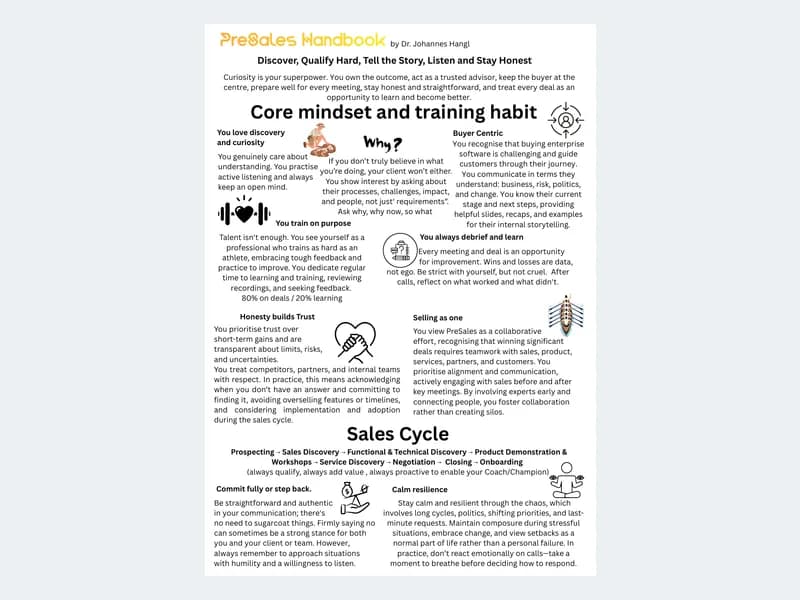 PDF · 1.0 MB
PreSales Handbook cheat sheet
The whole handbook on two pages: the presales mindset, the sales cycle, discovery questions and how to run a demo.
From the blog
- 2 min read
When a House of Cards Collapses: Why Radical Honesty Is a PreSales Superpower
A project I worked on failed badly. What it taught me about radical honesty, and why it is one of the strongest skills in presales.
Read more - 4 min read
The Rare Art of Caring: Why PreSales Must Lead with Craftsmanship and Conviction
In a world of shortcuts, caring about the work is rare. Why presales should lead with craftsmanship and conviction.
Read more - 5 min read
The Power of Curiosity in PreSales: Why It’s Your Greatest Asset
Curiosity drives better discovery, stronger relationships, sharper demos and calmer objection handling. Why it is a core presales skill.
Read more
In the course
- The PreSales MindsetMembers only
- Core Metrics for PreSalesMembers only
- Documentation & Knowledge SharingMembers only