

Applying for presales jobs · Lesson 67 of 75 · 9 min
What hiring managers test in presales
Presales hiring managers test three things before they test product knowledge: preparation, curiosity and creativity. Run your application like a sales cycle, and every round lets you do the job in front of the people who hire for it.
The application is a sample of the job
Most jobs ask you to describe your skills. A presales job lets you show them while you apply: you research, present, ask and make yes easy. That is the work of a solution consultant, and it is also the work of a good applicant.
A note on titles first. Solution consultant, sales engineer, solutions architect and presales specialist are names for the same job. The presales consultant chapter (opens in a new tab) lists more of them. This section uses "solution consultant", because it puts the solution before the feature.
The author of the handbook has interviewed many presales candidates. Three qualities stood out in the best of them: preparation, curiosity and creativity. The same qualities make a solution consultant good in front of a customer. So the hiring process is a small sample of the job itself. Treat it that way: you run a short sales cycle, and the product is you.
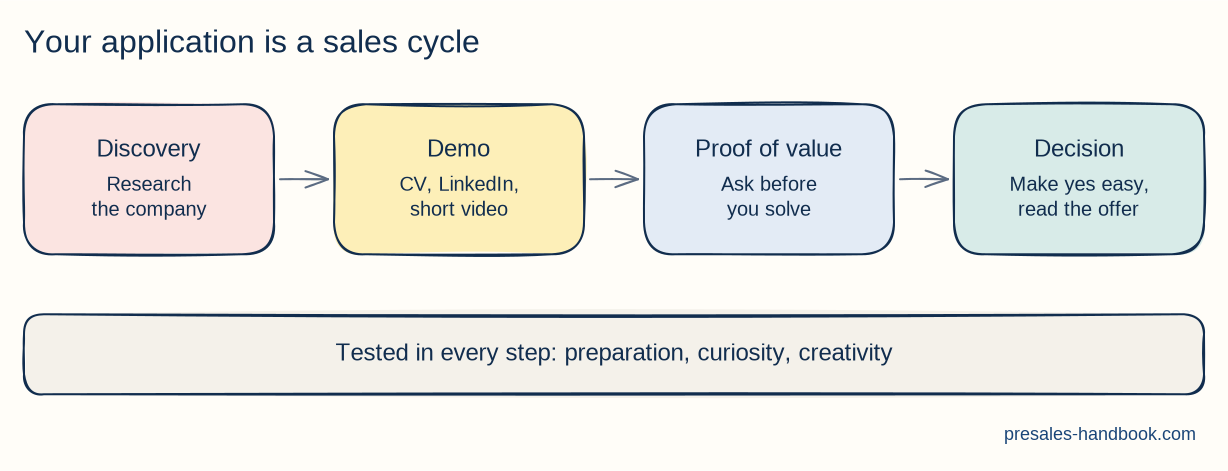
Your application runs like a sales cycle. The three traits show in every step.
Each step has its own lesson in this section. Discovery on the company (opens in a new tab) comes first. Your CV and LinkedIn (opens in a new tab) and a short video or mini deck (opens in a new tab) are your demo. The interview loop (opens in a new tab) and the demo round (opens in a new tab) are your proof of value. Reading the offer (opens in a new tab) is the decision.
Preparation: they notice it in minutes
In presales, the first rule is to come prepared. Before a demo you research the customer's business, think about the objections and tailor what you show. An application works the same way.
Interviewers notice effort almost at once. A candidate who knows the company's product and buyers sounds different from the first question. One who read only the job ad sounds like everyone else.
A generic CV and a template cover letter will not get you far. What works is a story that connects your past work to the company's business problems. If the vendor sells to logistics firms, your consulting project on a warehouse process matters, so say why it matters to their buyers.
Ten facts about the firm help less than one clear line on what its customers struggle with. The next lesson (opens in a new tab) shows how to build that picture fast, with an AI research prompt that sources every line.
Curiosity before polish
The best solution consultants ask good questions and dig past the first answer. In an interview this matters as much as in a deal.
Many interview loops, the series of rounds a company runs before an offer, still reward presenting. You get a task, you prepare for days and you deliver a smooth answer. A smooth answer shows preparation and stage presence. Curiosity only shows when something is missing.
So watch for the gap. A good hiring manager may give you a case with a hole in it on purpose. A buyer has a problem, and the brief does not say why. The polished candidate builds a demo for the problem as written. The curious one asks what is behind it before solving anything.
Listen for your own second question. "What happens then?" after the first answer is worth more than ten questions read from a list. It shows you listened.
Curiosity runs both ways. The handbook author's own loop includes a peer interview in which the candidate asks the questions. It shows whether you want to understand how the team works, and whether you want to join it. You qualify them while they qualify you.
Product depth is the part of the job a company can teach. Onboarding covers product training, role play and mentoring, as the leadership chapter (opens in a new tab) describes. Wanting to know why is much harder to teach, so a hiring manager forgives a thin product answer more easily than a missing question.
What this means in an interview:
- Do ask about the buyer's situation before you propose anything, in the demo round too.
- Do ask a follow-up that only makes sense after their answer.
- Do bring questions that qualify the team, such as how presales and sales split the work.
- Don't open with a feature tour or a rehearsed pitch about yourself.
- Don't fake product depth. Say what you know, then say how you would learn the rest.
- Don't bring customer names, demos or decks from your current employer. A hiring manager reads it as a sign you would do the same with theirs.
Creativity makes you memorable
If you send the same CV and cover letter as everyone else, you blend into the crowd. Creativity gets you into the next round.
The memorable candidates the handbook author has seen did small, concrete things. One sent a short video that explained who they were and why they applied. One shared a mini slide deck about their career and treated it like a customer presentation. One showed their home office setup as it would look on real calls.
A clear short video proves you can present, which is a core presales skill. A mini deck proves you can tell a story in a few slides. A clean setup proves you are ready for remote calls.
Keep it honest and small. A video does not replace preparation, and nobody can promise it gets you hired. The lesson on video, website and mini deck (opens in a new tab) shows how to make one without overdoing it.
A presales example
The example is invented, and so are the people in it. Lena is a business consultant who has spent years on logistics projects, but she has never held a solution consultant title. She applies at Tarnwick, a vendor of route planning software.
She prepares first. Tarnwick's public pages show who it sells to: food distributors and bakery groups with their own vans. Lena connects that to a project of hers, where she mapped how dispatchers plan routes by hand. She puts that project at the top of her CV and says in one line why Tarnwick's buyers would care.
Daniel, the presales manager, invites her to a first call and describes a case. A food distributor misses its delivery windows, and the head of logistics is unhappy. He asks how she would approach a first demo.
Lena leaves the slides closed and asks three questions. Since when are the windows missed? Who notices first, the driver, the dispatcher or the shop? What changed around the time it started?
Daniel smiles at the last one. The distributor's shops changed their opening hours in the spring. Routes were never re-planned for it. The brief never mentioned it, and Lena found it because she asked.
Later she meets Priya, a solution consultant on the team, for the peer interview. Here Lena asks the questions. How does a deal move from Tom, the account executive, to the presales team? What does a good first month look like? Lena takes notes for her own decision.
Lena also sends Daniel a plain, well-lit video of two minutes. In it she explains why she applies and what she would ask Tarnwick's buyers.
At the end Daniel's notes say little about her product knowledge. That gap is real, and Tarnwick can train it. What his notes do say is that she asked before she solved, found the hidden fact and presented clearly. Those were the three things he was testing.
Try it
This takes ten minutes. Use a job ad you are looking at, or one you would like to answer.
- Write the company's name and one line on what its buyers struggle with. If you do not know, note that as your first research task.
- Under preparation, note one piece of your past work that connects to that struggle. Write one sentence on why it matters to their buyers.
- Under curiosity, write three questions you would ask before solving a case from this company. Make one of them a follow-up you would only ask after an answer.
- Under creativity, pick one small proof of a presales skill: a short video, a mini deck or a picture of your setup. Note which skill it proves.
- Read the page back. Mark the weakest of the three. Work on that one first as you go through the next lessons.
What stays with you
- Presales hiring managers test preparation, curiosity and creativity, the same traits the job needs.
- Run your application like a sales cycle: discovery, demo, proof of value and decision.
- Ask before you solve. A follow-up question shows more than a polished answer.
- Product depth can be trained. Curiosity is much harder to add later.
- A video or mini deck is evidence of a presenting skill. It adds to preparation and never replaces it.
How AI changes this
As of November 2026
- What AI already does
- An assistant turns a job ad and public company pages into a short list of the buyer's likely problems and questions to ask.
- What stays with you
- You decide which of your own projects fit, you ask the follow-up questions in the room, and you check every fact the assistant gives you.
- Try this week
- Paste a public job ad and ask for three questions you would ask before solving a case from this company. Mark the one that is a real follow-up.
Keep going
Check what you learned
Pick an answer. You see right away if it is right.
Something wrong or unclear in this lesson?