

Stage 3 of 5
Functional & Technical Discovery
Functional & Technical Discovery: goals, best practices and who owns what in this stage of the selling journey.
In the Discovery stage, PreSales & Sales aim to uncover customer pain points, business objectives, organisational structure, and the customer's value hypothesis. They do this by conducting in-depth discovery sessions and meetings with the customer. The goal is to understand the customer's needs in depth and to see how their product or service can meet them.
Stage Goals
Figure out how to win and to develop a "Coach". Discover customer pain points, business objectives, and organizational structure to frame the solution's value proposition.
Best Practices
- Understand the Background: Start by understanding the prospect's business, their position in the industry, and their business goals. Use the BANT form and discuss the initial meeting with the prospect.
- Explore the Technical Environment: Look at the prospect's current technical infrastructure, including existing solutions, tech stack, and future plans. This will help in understanding how your solution can integrate or replace existing systems. Use a structured Questionnaire or the OSD to understand what is required.
- Identify Key Pain Points: Identify the major challenges the prospect is facing with their current setup. Look at the primary pain points and at related secondary issues that your solution could solve. Use a structured Questionnaire or the OSD to understand what is required.
- Quantify the Impact: Help the prospect quantify the impact of their pain points in terms of cost, productivity, and operational efficiency. These numbers help you build a strong case for your solution.
- Establish Solution Fit: Discuss specific capabilities of your solution that match the prospect's needs. This ties the discovery conversation to outcomes and benefits that matter to the prospect.
- Evaluate Extended Environment: Go beyond immediate needs and explore adjacent and impacted areas within the prospect's business that could benefit from your solution. This broader evaluation can uncover additional opportunities for your offering.
- Vision Reengineering: Encourage the prospect to envision a future state with your solution in place. Discuss the broader impact on their workflows and potential for reengineering their business processes for better results.
- Discuss Implementation and Adoption: Talk about the implementation process, expected challenges, and how your team would support the transition. Also, discuss the adoption process within their organization to ensure the solution is successfully embraced post-deployment.
- Create a Mutual Action Plan: Develop a plan that outlines the next steps both parties need to take following the discovery session. This should include timelines, key milestones, and responsibilities to maintain momentum towards a decision.
- Document and Share Discoveries: Summarize the discovery findings and share them with your prospect to confirm understanding and alignment. This document is the basis for all later steps and keeps both sides on the same page. Learn more about how to do Discovery (opens in a new tab)
- Document Details Thoroughly: Ensure all technical details, system requirements, and discussions are carefully documented in the OSD solutions.
- Focus on Business Outcomes: Frame your technical discovery in terms of business outcomes that matter to the prospect. Understand the key performance indicators (KPIs) they care about and how your solution can improve them.
- Use Cases and Scenarios: Ask the prospect to describe specific use cases or scenarios where their current systems are falling short. This helps you tailor your presentation to real situations the prospect cares about.
- Stakeholder Mapping: Identify all key stakeholders involved in the buying process. Understand their roles, influence, and individual pain points. This will help tailor conversations and demonstrations to address the concerns of each stakeholder.
Qualification Criteria
Qualify In (Next Stage Teach/Prove) (opens in a new tab)
- Discovery meetings completed and next steps scheduled.
- Clear view on the customer pain points and how we can bring value and ROI
- Org Chart & Power Base chart developed, and decision-maker known.
- Evaluation plan confirmed, verbally or in writing.
Qualify Out (Maybe move to Long-Term-Development) (opens in a new tab)
- Target is unwilling to engage in discovery meetings or provide necessary information.
- No relationship with management and no clear coach
- No clear understanding of the client's pain points, objectives, and decision-making process
Functional & Technical Qualification Framework
Basics
FTQ Framework (opens in a new tab)
Course Functional Technical Qualification (FTQ)
Download Functional Technical Qualification Template
FTQ Template (opens in a new tab)
Do's and Don'ts
Do
- Ask open-ended questions during discovery, gather information on organisational structure, and confirm evaluation plan.
Don't
- Skip discovery, make assumptions about the prospect's needs, or neglect to involve key stakeholders.
- Do demos without knowing the pain.
Responsibilities & Tasks
Sales (ASD/SD)
- Inform the Solution Consultant about the new opportunity
- Update the OSD with the Situation Sheet ( Critical Business Issues, Problems & Reasons, Capabilities, Delta and Value Realization Event). Share insights and information about the prospect to help the PreSales team better understand their needs and expectations.
- Conduct discovery meetings, involve key stakeholders, and develop a detailed understanding of prospect's needs.
- Develop Organisation Chart (Understand who is the Champion, Decision-Maker, Coach, Distractor, etc)
- Involve the AVP Sales to build the relationship at an early stage
- Solidify the Coach & enable them to sell our solution internally
- Conduct discovery meetings to understand customer pain points and business objectives.
- Use effective questioning techniques (e.g., SPIN framework) to gain insights into customer needs.
- Collaborate with PreSales and Product Management to develop tailored solutions for the customer.
- Create Estimate/ Ballpark pricing,
PreSales (SC)
- Understand the customer's functional & technical environment and requirements to provide relevant insights.
- Qualify if and how to win it.
- Maintain an up-to-date knowledge of the product portfolio and its applications.
- Work closely with Sales to create customized product demonstrations showing the solution's value.
- Perform Look & Feel Demo
- Update the OSD with the Situation Sheet ( Critical Business Issues, Problems & Reasons, Capabilities, Delta and Value Realization Event)
- Present the Opportunity to PS/PM in case of gaps (Opportunity Review Call (ORC)
Professional Service (PS)
- Offer insights on implementation, integration, and customisation possibilities.
- Understand the project
- Collaborate with Sales and PreSales to understand customer requirements and plan for implementation.
- Use insights from discovery meetings to develop a detailed project plan for solution delivery.
- Support Sales and PreSales in addressing customer concerns related to implementation and service delivery.
Product Management (PM)
- Collaborate with Presales to ensure a product fit
- Qualification (ORC)
- Use feedback from Sales and PreSales to refine product offerings and address customer needs.
- Collaborate with Sales and PreSales to develop tailored solutions that align with customer objectives.
- Support the discovery process by providing product-specific insights and expertise.
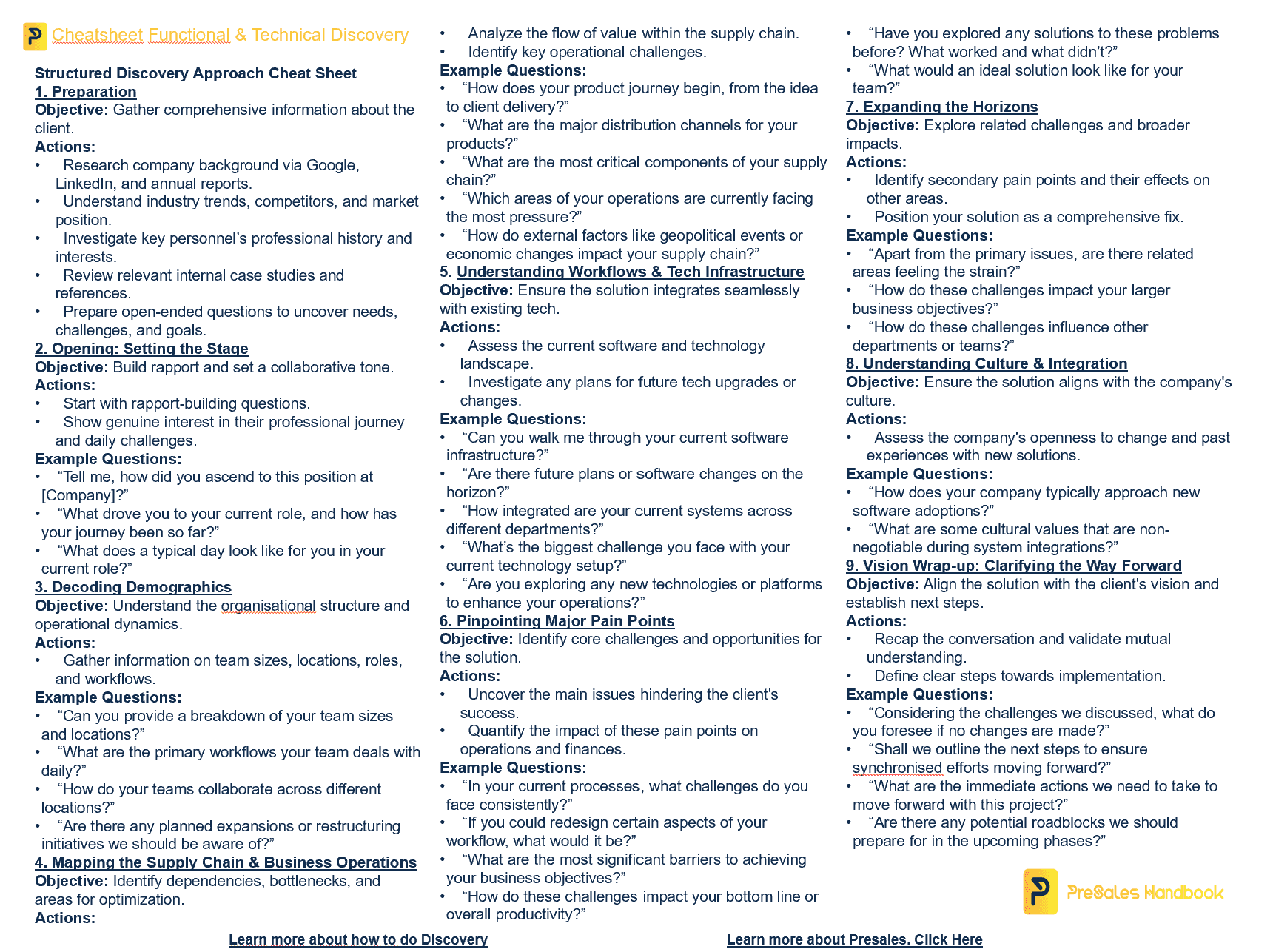
Cheatsheet: Functional & Technical Discovery
Additional Materials
Information
Discovery Basics (opens in a new tab)
Discovery Guidebook
Guidebook (opens in a new tab)
FTD Template
FTD Template (opens in a new tab)
FTQ Template (download)
FTQ Template (opens in a new tab)
Functional & Technical Discovery
Functional & Technical Discovery Best Practices
The Discovery Summary / Opportunity Scoping Document (OSD)
Functional Technical Discovery Template
Situation Sheet (internal)
Attendee (Name and Role)
"Tell me, before we get started, how did you ascend to this position of power and authority at [Clientname]?"
Demographics
Tell me about your team – how many people? Where are they located? How long have they worked at [XX]? How is the company organised? Locations? Brief history?
Sales Discovery Summary
"[Mr. or Mrs. Customer], my colleague Mike has given me some background on the project, and I understand you're looking to accomplish XYZ. Since I'll present our solution on site, I'd like a few minutes to ask you some more questions. That way I can make sure I fully understand what you're looking for from a technical perspective. Then the demonstration on site will be the best use of your time. Is that an agreeable approach for you?"
"I understand from Mike that you are trying to do XYZ. Could you give me a 30- or 60-second overview of the project in your own words, just to make sure we're on the same page?"
Workflows
How many different workflows do you have? - Where are they located? - Are the individual workflow components distributed or in single facility? – Are the workflows physical (e.g. pure paper), fully digital, or a hybrid? How long have these workflows been in place? - How many people are involved? Ask about that team's experience and backgrounds; are they experienced in their practices or unskilled? - Who (or what) are the customers for these workflows and similarly what are the inputs?
Solution Landscape
(ERP systems, WMS, GTM) What is your prospect's current software infrastructure – their "tech stack" – and what are their plans for the future? Does the organisation have any previous experience with other tools or solutions like ours? If so, how did it go? If it failed, why?
Situation Sheet (external)
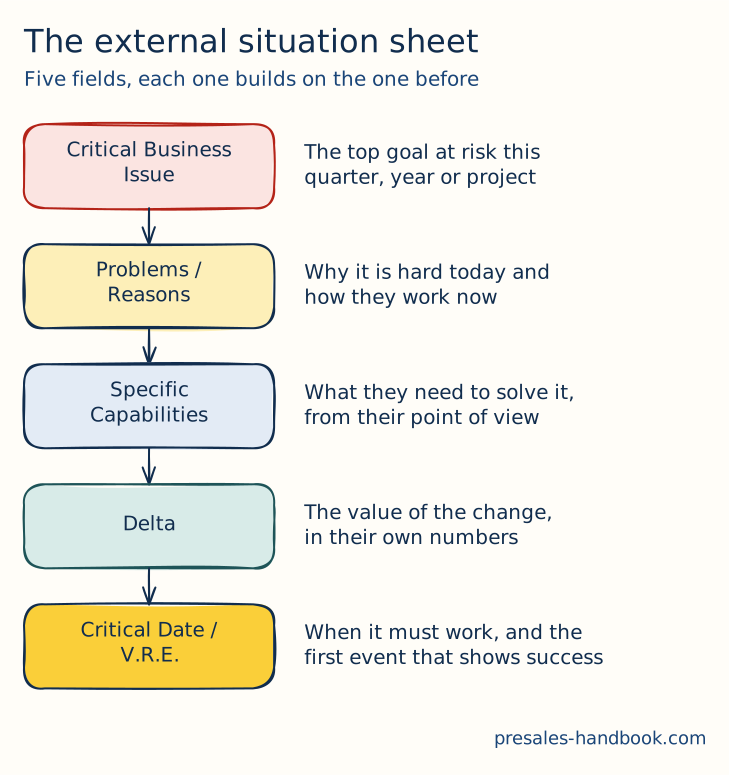
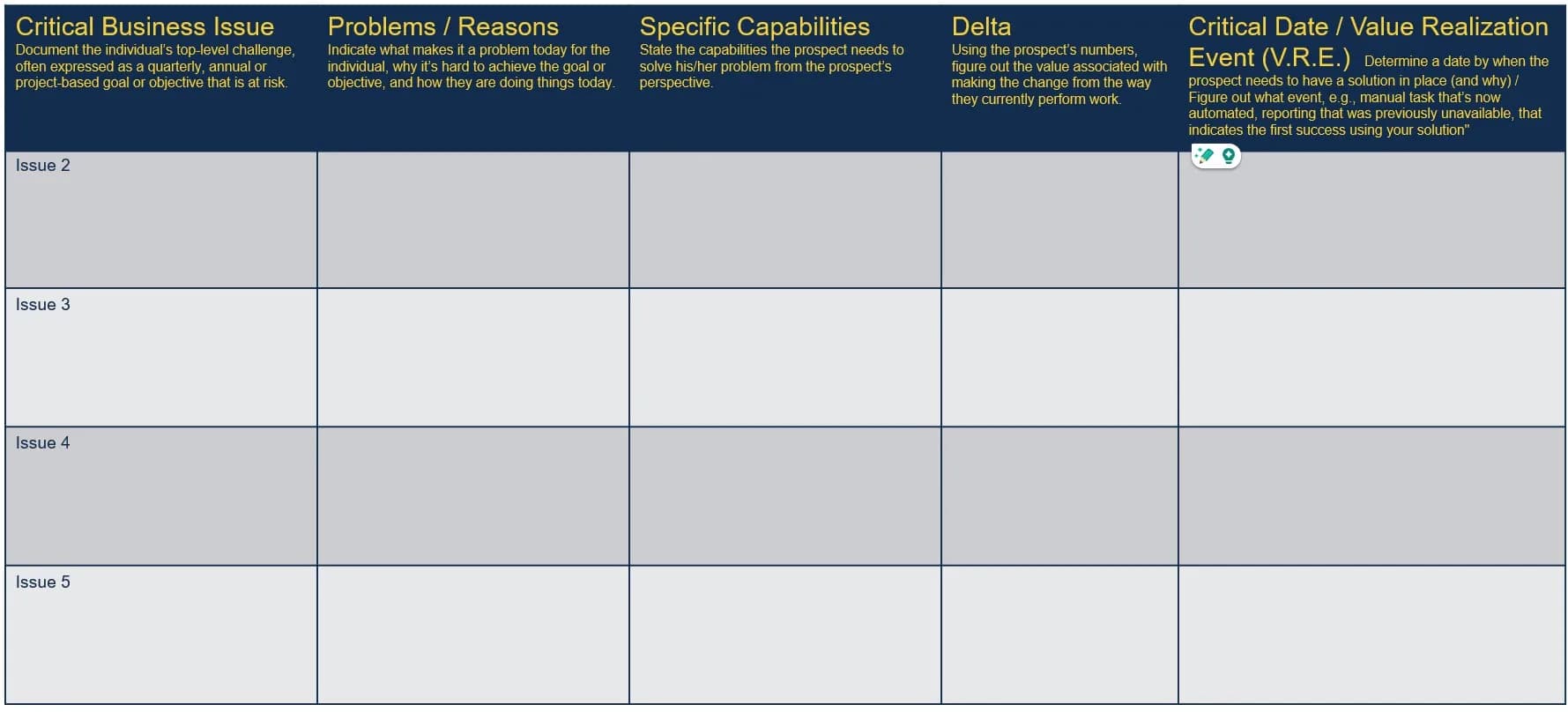
Critical Business Issue
Document the individual's top-level challenge, often expressed as a quarterly, annual or project-based goal or objective that is at risk.
Problems / Reasons
Indicate what makes it a problem today for the individual. Explain why it's hard to achieve the goal or objective, and how they are doing things today
Specific Capabilities
State the capabilities the prospect needs to solve his/her problem from the prospect's perspective.
Delta
Using the prospect's numbers, figure out the value associated with making the change from the way they currently perform work.
Critical Date / Value Realization Event (V.R.E.)
Determine a date by when the prospect needs to have a solution in place (and why). Figure out what event indicates the first success using your solution. Examples are a manual task that's now automated, or reporting that was previously unavailable.
Volume, Culture, Process
Volumes and Measurements
(No of Products, Partners, BOM, Complexity, locations, productions sites, main countries in scope)
Culture
Tell me, is there anything that makes you unique, as a company? How will you begin to know that the new software is a success? Shall we explore a few small "wins" that might be representative? What would you consider to be an early win, a small success, once you begin to work with the new lists and services? Is this problem getting worse? How has it changed over the past XX [days, weeks, months, etc.]?
Process, timelines, budget etc
What happens if you do nothing? How long is "a while"? Why is it possible to continue in the current mode? What will it take to make the change – what has to take place? Are you early in your exploration of XX or are you at the point where you are actively seeking a solution? Is there a date by when you need to have a solution in place? Then you ask: And what is driving that need? (A Critical Date (or Critical Event) is a date by when the prospect needs to have a solution in place. It includes an explanation of why that date is important). Tell me, what prompted you to reach out to us? We've been discussing your situation for a while and I'm beginning to feel like I understand it reasonably well. But tell me, why did you reach out to me in the first place? Are there specific goals or objectives that you need to achieve, or that are at risk? Measurements today?
Demo Meeting
Attendance, Roles and Meeting location
Who's going to be in attendance? What are their roles? Are they hand-on users, technical principals, management, decision makers, etc.? What are the meeting logistics? Is it a secure environment? Will I have internet access? Are we meeting in a conference room or someone's office?
After Discovery
Do we have a solution for their problems? Do we understand the key problem and what is it ?